
Screen Time Rules That Work for Busy Mumbai Parents
Tired of tablet battles in your Mumbai apartment? Here are realistic screen time rules that work for urban families, complete with MMR-friendly offline alternatives.
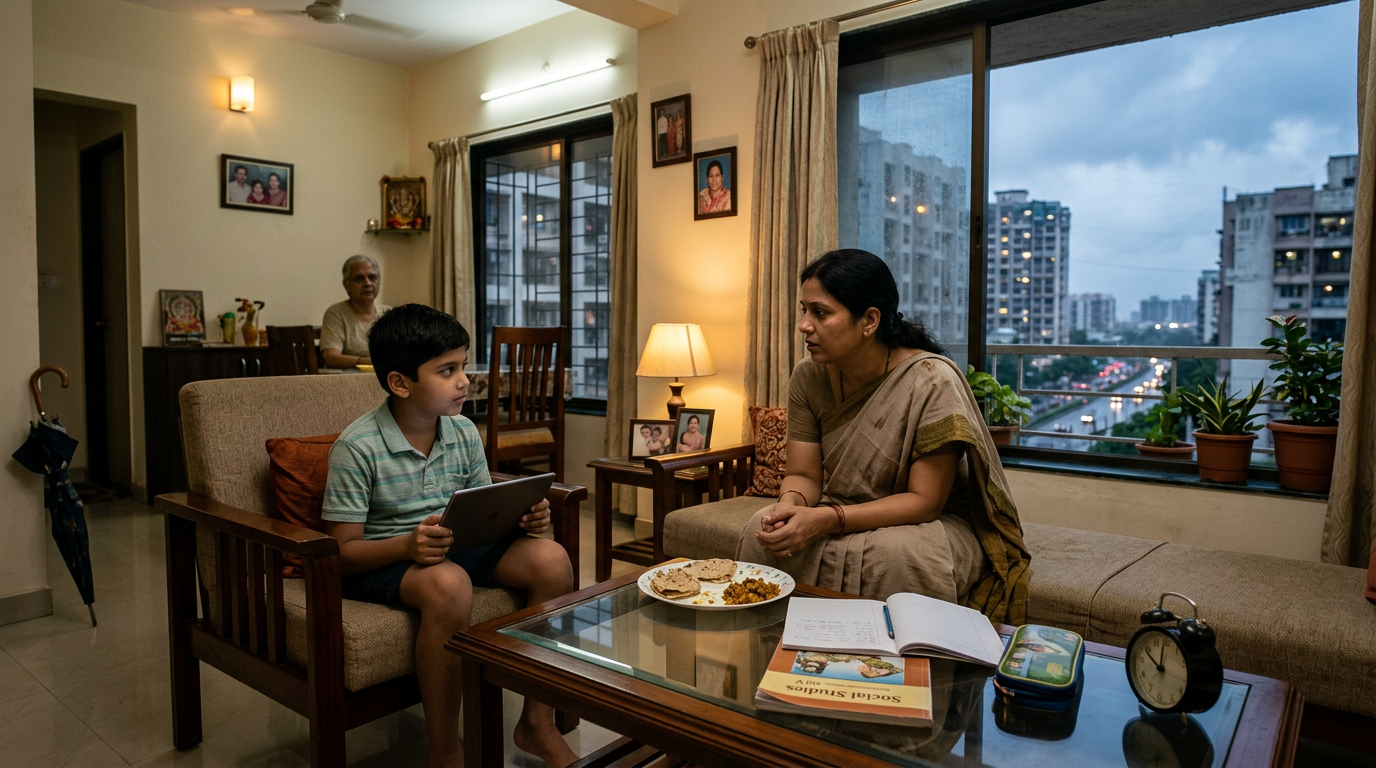
Step inside almost any 2BHK in Goregaon or a high-rise apartment in Vashi around 7:30 PM, and you will witness the exact same standoff. Dinner is cooling on the dining table, homework diaries lie half-opened, and an exhausted parent is pleading with a ten-year-old to switch off YouTube. Living in the Mumbai Metropolitan Region (MMR) brings unique pressures: space is tight, traffic stretches our workdays, and monsoons frequently trap kids indoors. That is why finding screen time rules that work is not about chasing an impossible tech-free utopia—it is about restoring peace, focus, and connection to our urban households.
Most digital wellness advice feels detached from urban Indian reality. Silicon Valley executives who ban tablets usually have sprawling backyards and dedicated playrooms. When you live in a 650-square-foot apartment along the Western Express Highway with two working parents, screens often become an accidental digital babysitter. The good news? You do not need to confiscate every device to reclaim your family life. By implementing realistic, culturally grounded boundaries, you can cultivate healthy tech habits that your children will actually respect.
The MMR Screen Dilemma: Compact Flats, Monsoons, and Traffic
To establish healthy boundaries, we must first acknowledge why children in Mumbai, Thane, and Navi Mumbai consume so much media in the first place. Our built environment plays a massive role. In neighborhoods like Lower Parel, Dadar, or Chembur, open recreational grounds are rare luxuries. Even in planned nodes like Kharghar or Nerul, intense summer heat or relentless July downpours often eliminate outdoor playtime for weeks at a time.
Add to this the brutal logistics of our city. When parents spend ninety minutes navigating the Eastern Freeway or crowded local trains between Churchgate and Borivali, they return home drained. Handing a child an iPad for thirty minutes of quiet while dinner is prepped is an understandable survival mechanism, not bad parenting. The trouble begins when thirty minutes quietly stretches into three hours every evening.
Recognizing these environmental triggers helps you let go of parental guilt. The goal is not perfection; it is intentional management. When you address the spatial and environmental constraints of Mumbai living, you can design routines that accommodate your child's natural restlessness without defaulting to infinite algorithmic feeds.
Rule 1: Anchor Screens to Routines, Not Arbitrary Clocks
Telling a child they have "forty minutes of iPad time" rarely works. Inevitably, the timer goes off mid-game or halfway through an episode, triggering an instant meltdown. A far more effective approach is behavioral anchoring: linking screen privileges to specific daily milestones rather than a fluctuating timer.
In a standard MMR household, an anchored routine might look like this:
- School bag unpacked and uniform in the laundry bin: Zero screens during this post-school transition window.
- Society compound play or physical movement: At least 45 minutes of running around the building courtyard, clubhouse, or local municipal park.
- Schoolwork and revision complete: Academic responsibilities take precedence while energy levels are intact.
- The Screen Window: Once those tasks are accomplished, a predictable 45-minute block opens before dinner.
When media access is tied to tangible completions, children stop negotiating. The boundary is clear: screens follow duties, they do not precede them. For older students balancing tuition classes in spots like Andheri West or coaching centers in Thane West, anchor screen breaks between study blocks rather than leaving devices open on study desks while revising.
Rule 2: Establish Sacred Screen-Free Zones in Your Apartment
Because city apartments require smart spatial management, physical boundaries reinforce mental boundaries. When children associate their beds or eating spaces with glowing screens, sleep hygiene collapses and mindful eating disappears.
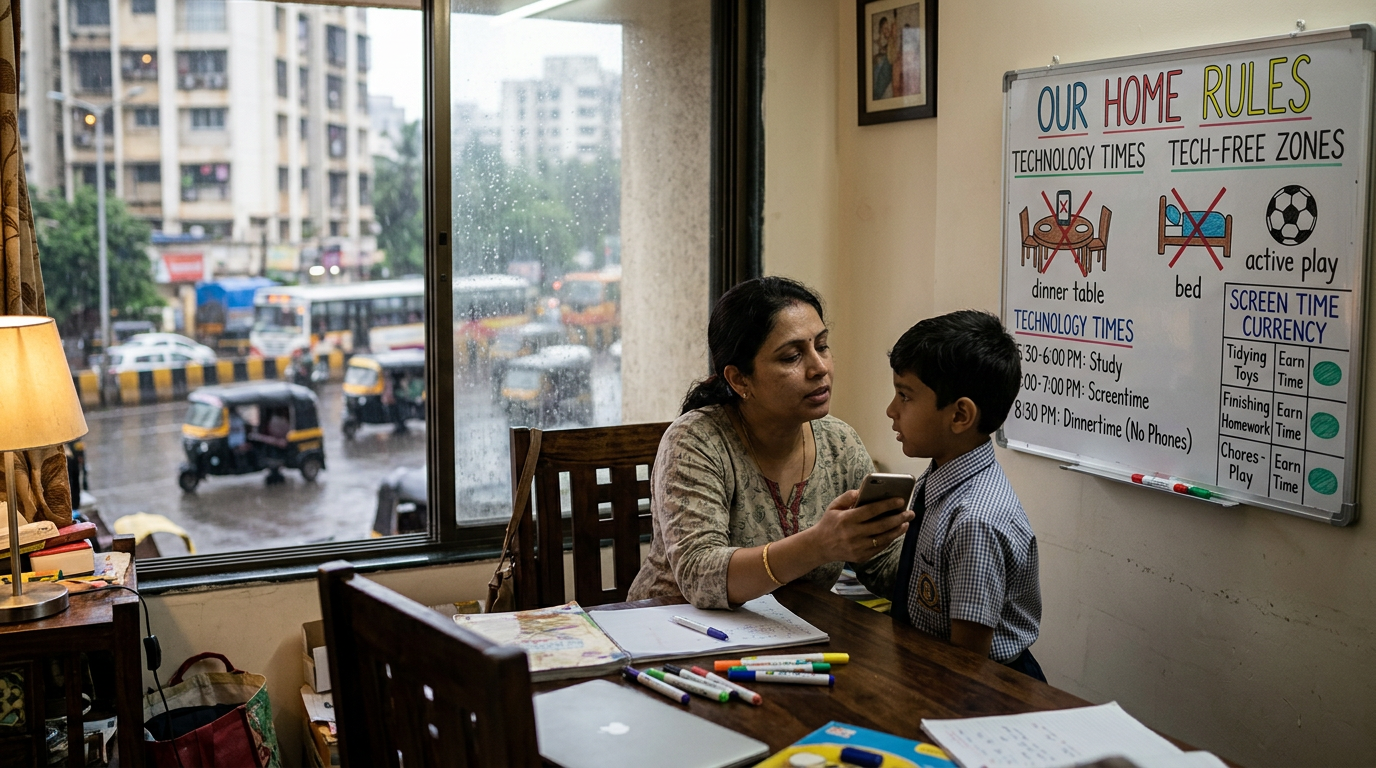
The Dining Table is Non-Negotiable
Whether having quick poha before the 7:00 AM school bus or sharing dal-chawal at night, keep devices off the dining table entirely. This includes parents. If your phone buzzes with a work Slack notification or an apartment society WhatsApp ping, let it wait. Children model what they see far more than what they are told.
Bedrooms Remain Tech-Free Sanctuaries
Make bedrooms charging-free zones. Set up a central family charging station in your living room or passage hallway. At 8:30 PM, every device—laptops, iPads, and smartphones (parents included)—must be docked there for the night. Removing the temptation of late-night scrolling drastically improves sleep quality, ensuring your child can actually wake up refreshed for their morning commute.
"A child who falls asleep scrolling in a dark bedroom is not resting; their brain remains wired on high alert. If you want calmer mornings, remove the charger from their bedside table."
For more ideas on structuring your child's domestic environment for focus and calm, explore our guide on [INTERNAL_LINK: home study spaces for mumbai apartments].
Rule 3: Implement the Physical 'Trade-In' System
One of the screen time rules that work best for school-age children is a visible exchange mechanism. When kids ask for tech time, give them an active choice through a trade-in framework. Instead of a blanket "no," offer an empowering "yes, after."
Try using a token or card system on your refrigerator. To earn 30 minutes of console gaming or YouTube streaming, your child completes one physical or creative offline task:
- Reading: Twenty pages of a book (borrowed from local institutions like the NCPA library, David Sassoon Library, or neighborhood circulating book clubs).
- Creative play: Completing a Lego build, sketching, or practicing an instrument without adult supervision.
- Household contribution: Folding their laundry, laying out plates for dinner, or watering the balcony plants.
- Active movement: Skipping rope for fifteen minutes or practicing badminton drills down in the building stilt parking area.
This method breaks the passive consumption cycle. It teaches children that digital entertainment is an earned luxury rather than an automatic default during downtime.
Rule 4: Set a Firm Sunset Curfew Aligned with School Transit
Schools across Mumbai—from Cathedral and John Connon in Fort to DPS Nerul or Singhania School in Thane—start remarkably early. Many students board buses between 6:15 AM and 6:45 AM, enduring bumpy journeys before the first bell even rings. If your child is looking at blue light until 10:00 PM, their circadian rhythm is compromised.
Enforce an unwavering digital sunset at least sixty minutes before lights out. If bedtime is 9:30 PM, all devices must be turned off by 8:30 PM. Use this final hour for low-stimulation wind-downs: warm baths, reading physical storybooks, or simply chatting about their day.
If you notice heavy resistance, frame the curfew as a biological necessity rather than a punishment. Explain how blue light tricks their brain into thinking it is noon along Marine Drive instead of night, preventing the production of melatonin. Kids are surprisingly receptive to biological explanations when presented clearly.
Rule 5: Prioritize Co-Viewing Over Isolated Scrolling
Not all screen exposure carries the same developmental weight. Passively watching brain-rot short videos on mobile feeds isolates kids and spikes dopamine in unsustainable bursts. On the other hand, watching a long-form nature documentary, a family film, or playing a cooperative console game together on a shared television screen is an active, bonding experience.
Shift the balance of your family's media intake toward shared viewing:
- The Big Screen Standard: Whenever possible, push viewing onto the living room television rather than personal smartphones or tablets tucked away in private corners.
- The Dialogue Habit: Ask questions about what you are watching together. "Why do you think that character made that decision?" or "Have you ever felt like that at school?"
- Educational Deep Dives: If your child is obsessed with marine life, balance animated clips with high-production ocean documentaries. Follow up over the weekend with an actual trip to the Taraporewala Aquarium promenade or an organized shore walk at Haji Ali or Juhu Beach.
Transforming screen time into a conversational launchpad mitigates its passive, numbing effects and turns media into a shared cultural reference point for your household.
Rule 6: Manage Meltdowns and Peer Pressure Realistically
"But mom, everyone in my class at Oberoi International has their own smartphone!" This is the classic refrain every urban parent dreads. Peer culture in Mumbai schools can be fiercely tech-centric, with children discussing viral trends, Discord servers, and mobile games from primary school onward.
Handling this social pressure requires empathy paired with steadfast firmness. Acknowledge their desire to fit in without capitulating to demands that contradict your family values. Connect with other parents in your child's class group; you will often discover that several families share your exact concerns and are equally relieved to form a united front against premature phone ownership.
When digital tantrums do occur, remain steady. A meltdown is simply your child's overstimulated nervous system struggling to regulate after an intense dopamine surge. Do not match their volume or negotiate mid-tantrum. Simply state: "I know you are upset that the game is over. It is hard to stop when something is fun. But our screen time for today is done." Offer a physical alternative—a glass of water, a quick walk down to the society gate, or a quiet hug. Learn more about emotional co-regulation in our breakdown of [INTERNAL_LINK: managing childhood anxiety and school stress].
Offline MMR Alternatives That Can Actually Compete with Screens
You cannot simply take away screens and leave children sitting in an empty room staring at walls. If you want screen time rules that work sustainably, you must replace the digital vacuum with genuinely engaging offline options. Fortunately, the Mumbai Metropolitan Region offers exceptional community and cultural spaces if you know where to look.
1. Green Spaces and Physical Outlets
Make outdoor excursions non-negotiable weekend anchors. Spend Sunday mornings exploring the biodiversity trails at Sanjay Gandhi National Park in Borivali, cycling the expansive avenues of Central Park in Kharghar, or flying kites along the Palm Beach Road promenade in Navi Mumbai. Even an hour spent kicking a football at Shivaji Park in Dadar or joining a weekend roller-skating class in your building compound will burn energy that otherwise transforms into screen-seeking restlessness.
2. Board Game Cafes and Maker Spaces
When the monsoon makes outdoor fields unusable, explore interactive indoor hubs. Locations like Pair a Dice Cafe in Oshiwara, Dastaan in Bandra, or various hobby centers in Powai and Thane host regular family board game sessions. These introduce kids to complex, collaborative tabletop games (like Catan, Ticket to Ride, or Carcassonne) that activate strategic thinking without a single pixel in sight.
3. Local Libraries and Creative Workshops
Nurture an analog appetite by visiting historic public libraries. A trip to the Asiatic Library in Fort or the newly restored David Sassoon Library provides an awe-inspiring cultural outing that instills a reverence for physical print. Look out for weekend pottery workshops in Bandra West or robotics maker classes in Mulund that channel your child's curiosity into hands-on craftsmanship.
Creating a Written Family Tech Agreement
Rules that live solely in your head will lead to daily arguments. Sit down together on a calm weekend afternoon and co-create an explicit "Family Tech Agreement." When children have a voice in establishing rules, their buy-in increases dramatically.
Your simple, single-page agreement should clearly state:
- Exact windows when recreational screens are permitted (e.g., 5:30 PM – 6:15 PM on weekdays).
- Specific physical zones where devices are strictly banned (dining table, bedrooms, bathrooms).
- Clear parental commitments (e.g., parents put work laptops away during dinner and do not check notifications during family board games).
- Direct, predictable consequences for violations (e.g., losing screen privileges for the following day without yelling or negotiations).
Have every family member sign the paper and pin it visibly on the refrigerator or hallway noticeboard. When friction arises, point calmly to the agreement rather than becoming the arbitrary disciplinarian.
Consistency Over Perfection
Parenting in the Mumbai Metropolitan Region is demanding. There will inevitably be days when a child is running a fever, a deadline strikes, or torrential rains shut down transit, forcing you to rely on Netflix to keep the peace. That is completely normal. Healthy digital hygiene is not measured by single days; it is defined by long-term patterns.
By establishing physical tech boundaries, prioritizing shared viewing, and swapping solitary scrolling for the rich cultural life our city offers, you can raise grounded, imaginative children who know how to use technology as an empowering tool rather than an all-consuming escape.
Ready to transform your home's digital habits? Pick just one rule from this guide—like making the dining table a phone-free zone—and implement it tonight. Share your family's experience in the comments below, or check out our curated guide to [INTERNAL_LINK: best outdoor weekend activities for kids in navi mumbai] to start planning your next tech-free adventure!
Keep reading
Practical Screen Time Rules for Mumbai & Navi Mumbai Parents
In a city like Mumbai, managing your child's screen time feels like a constant battle. Here are realistic screen time rules that actually work for families in the MMR, from Bandra to Belapur.
Screen Time Rules That Work for Mumbai & Navi Mumbai Kids
From Bandra to Belapur, Mumbai parents are asking how to manage tablets and phones. Here are screen time rules that actually work for our city's unique challenges.

How to Raise Resilient Kids in the Heart of Mumbai
Stuck on the Harbour Line during a downpour? That's just a Tuesday. This guide explores how to raise resilient kids who can thrive amidst Mumbai's unique chaos and charm.