
How to Spot AI Generated Images: A Mumbai Guide to Fact-Checking
From fake monsoon flood pictures along Marine Drive to synthetic luxury flats in Navi Mumbai, here is the definitive guide on how to spot AI generated images before sharing.
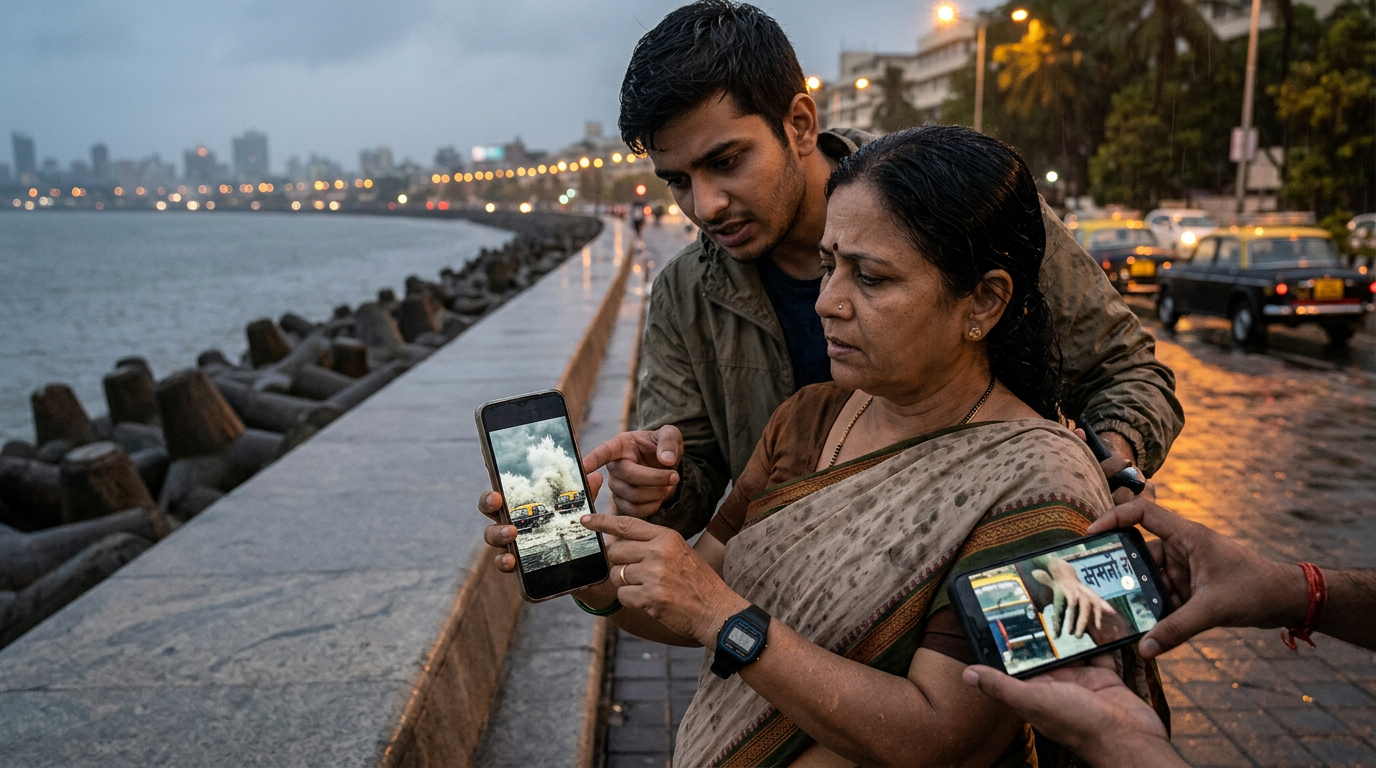
Last July, right as the monsoon peaked over South Mumbai, a dramatic image made the rounds across hundreds of residential WhatsApp groups in Bandra and Colaba. It showed a massive tidal swell crashing over the promenade at Marine Drive, sweeping yellow-and-black premier padmini taxis into the Arabian Sea. It took less than twenty minutes for panic to set in before civic reporters confirmed the water was calm. The image was synthetic—rendered in Midjourney and distributed within minutes. Learning how to spot AI generated images is no longer just a pastime for digital artists; it has become an essential life skill for anyone living in the hyper-connected Mumbai Metropolitan Region (MMR).
The Mumbai WhatsApp Epidemic: Why Synthetic Images Spread Fast Here
The Mumbai Metropolitan Region thrives on fast information. With millions commuting daily on the Western and Central railway lines, commuters depend on real-time transit alerts, rain forecasts, and municipal advisories. This creates the ideal breeding ground for synthetic media. When bad weather strikes, our reflex is to alert family and friends immediately, bypassing basic verification.
Generative AI tools such as Stable Diffusion, Midjourney v6, and DALL-E 3 have matured rapidly. Two years ago, fake photos were blurry, distorted messes that anyone could dismiss within a fraction of a second. Today, creators can type a simple prompt and generate hyper-realistic depictions of a crowded Dadar flower market, a fictitious political gathering outside Mantralaya, or an imaginary mega-flyover running through Navi Mumbai's Kharghar hills.
The danger is not limited to panic during natural disasters. Fraudulent real estate developers promote off-plan projects in peripheral nodes like Ulwe or Dombivli using synthetic renders disguised as actual site photographs. Job recruitment scams circulate fabricated appointment letters alongside AI-generated photos of corporate headquarters in Bandra-Kurla Complex (BKC). To protect yourself and your family, you need a disciplined, systematic approach to evaluating every striking image that lands on your smartphone screen.
Anatomical Glitches: Hands, Eyes, and Teeth
Despite rapid advances in deep learning, artificial neural networks still do not understand the physics or biomechanics of the human body. They assemble images based on statistical associations between pixels, which often leads to bizarre anatomical errors.
The Tell-Tale Hands and Fingers
Hands remain the ultimate stress test for image generation models. Rendering five articulated digits requires calculating intricate perspectives, occlusions, and foreshortening. When an AI attempts to generate a crowd of commuters boarding a fast local at Churchgate, inspect the hands holding the grab handles. You will frequently find:
- Six or seven fingers on a single hand, or an unnaturally missing thumb.
- Fingers that blend together like melted wax or morph straight into handles and railings.
- Joints bending at impossible, agonizing angles without any sign of muscular tension.
- Fingernails rendered on both the front and back surfaces of knuckles.
Eyes, Irises, and Uncanny Smiles
The human face is another prime indicator. When evaluating a portrait—say, a supposed photograph of a local Mumbai corporator or a celebrity spotted dining at a café in Pali Hill—zoom into the pupils. In authentic photography, the light reflection (the catchlight) matches across both eyes, mirroring the actual light sources in the environment. AI-generated faces routinely exhibit mismatched catchlights: one eye might reflect an indoor fluorescent bulb while the other displays an outdoor sunburst.
Furthermore, look at the pupils themselves. AI frequently produces pupils that are misshapen, oval, or jagged rather than round. Teeth present a similar challenge. While human mouths show varying spacing, incisor shapes, and natural dental anatomy, synthetic faces often feature a terrifying, uniform strip of porcelain-white enamel resembling an unbroken zipper, occasionally packing 36 to 40 teeth into a single mouth.
Architectural and Environmental Inconsistencies
Anyone who walks through the lanes of Fort, Dadar, or Vashi knows the distinct, messy texture of MMR architecture: century-old basalt stones mixed with modern glass façades, exposed cabling, distinct air conditioning compressor brackets, and monsoon weathering stains. AI models struggle to replicate this layered urban reality.
Surreal Landmarks and Missing Context
When an AI tool creates a supposed shot of South Mumbai, it often hallucinates architectural mashups. You might see the dome of the Chhatrapati Shivaji Maharaj Terminus (CSMT) awkwardly perched on top of a building resembling the Taj Mahal Palace Hotel, flanked by generic American skyscrapers. The AI understands the semantic tags associated with "Mumbai architecture" but possesses no spatial awareness of where these landmarks actually sit relative to one another.
Check the horizon lines and perspective grids. If an image claims to show the view of the Arabian Sea from a new residential tower in Worli, track the coastline. Are the Bandra-Worli Sea Link cables aligning mathematically? In synthetic images, suspension cables frequently vanish into thin air, split into parallel duplicates, or anchor into open water rather than structural pylons.
Shadows, Lighting, and Physical Illogic
Natural light follows strict optical laws. If the noon sun is beating down on an open stretch of Palm Beach Road in Navi Mumbai, shadows must project uniformly away from the light source. AI models, however, render objects in isolation before blending them together, creating competing light sources.
"Physics is the ultimate enemy of generative image engines. A computer can fake an aesthetic, but it constantly fails to calculate the consistent bounce of light across complex, multi-surface environments like a Mumbai street."
Look closely at how light interacts with translucent materials. In a genuine photograph of a rainy evening on Linking Road, puddles reflect the neon signage of shoe stores, headlights, and rain droplets hitting the asphalt. In an AI image, puddles often look like flat gray mirrors or smooth mercury pools that reflect objects that do not exist in the frame.
Text, Signboards, and Devanagari Script Nightmares
One of the most reliable ways to spot AI generated images in an Indian context is to read the writing on walls, vehicles, and signboards. AI image models process text not as linguistic characters conveying meaning, but as visual patterns. While English text generation has improved in recent versions of DALL-E and Midjourney, complex scripts—specifically Devanagari (used for Marathi and Hindi)—remain an insurmountable hurdle for current tools.
Gibberish on BEST Buses and Auto-Rickshaws
Every Mumbaikar recognises the distinctive typography of a red BEST bus, the yellow route plates, and the meter fixtures on an auto-rickshaw in the suburbs. Synthetic images that simulate these vehicles almost always fail at the fine details:
- The Destination Board: The route name on an AI bus will look like Marathi at a fleeting glance, but closer inspection reveals pseudo-Sanskrit glyphs, missing vowel matras, and invented consonants that do not exist in any Indian language.
- Auto Meters and Plates: The black-and-yellow fare display or registration plates (e.g., MH-02, MH-03, MH-43) will feature illegible, wavy numbers that morph between Latin letters and numbers.
- Commercial Billboards: Street scenes along the Western Express Highway will display roadside hoardings featuring simulated corporate logos that resemble familiar telecom or bank brands but dissolve into meaningless geometric smears upon zooming in.
Whenever an image surfaces depicting a dramatic incident—a bus breakdown, a flash protest, or a celebration—ignore the central subject for ten seconds. Direct your eyes straight to the background signage. If the Marathi or English text looks like alien hieroglyphs, you are unquestionably looking at synthetic media. Read more about protecting your personal accounts in our guide on [INTERNAL_LINK: social media security practices].
Fabric, Textures, and the 'Midjourney Sheen'
There is a distinct aesthetic fingerprint that seasoned investigators call the "Midjourney sheen" or the "plastic wrapper effect." Because many foundation models are trained on curated digital photography portfolios and 3D rendering engines like Unreal Engine 5, they over-compensate on detail, producing an unnaturally polished finish.
The Plastic Skin Paradox vs. Mumbai Humidity
Mumbai has an average relative humidity that rarely drops below 60 percent. People sweat; skin has pores, blemishes, micro-wrinkles, and uneven pigmentation. Real street portraits shot at Bandra Bandstand or near Juhu Beach show authentic skin texture under coastal sunlight.
AI skin, by contrast, frequently exhibits an uncanny airbrushed quality. Faces appear poreless, slightly translucent, and covered in an artificial satin sheen that looks more like silicone wax than human epidermis. Alternatively, newer models attempt to add realism by plastering an exaggerated, uniform "freckle map" across cheeks and noses, creating a stippled look that doesn't follow natural skin variation.
Clothing, Folds, and Jewelry Details
Pay close attention to traditional Indian clothing. The drape of a nine-yard Nauvari saree, the pleats of a kurta, or the embroidery on a wedding lehenga demand a complex understanding of gravity and tension. Generative engines routinely botch these intersections:
- Fabric patterns that change scale or vanish when passing behind an arm or under a collar.
- Mangalsutras, chains, or lanyards that fuse directly into skin, collarbones, or shirt collars.
- Earrings that do not connect to earlobes, floating a few millimetres away in mid-air.
- Buttons that do not align with buttonholes, or buttonholes sewn over solid fabric without openings.
Digital Forensics: Simple Tools Anyone in MMR Can Use
You do not need a computer science degree from IIT Bombay to run forensic checks on suspicious media. When a viral image raises doubts, you can deploy a straightforward investigation routine right from your phone or laptop using free, public tools.
Step 1: Reverse Image Search with Google and Yandex
The fastest way to verify an image is to trace its provenance. If a Twitter account claims that a bridge near Belapur just cracked, save the image and upload it to Google Lens or Yandex Images. Yandex is notably effective at indexing visual patterns across global and regional forums.
Often, a reverse image search reveals that the exact file was posted hours earlier on a forum like Reddit's r/midjourney or a digital art group with the caption: "Concept art of a futuristic bridge in Navi Mumbai." Tracing the original upload instantly dispels the rumor. You can also monitor trending digital threats through our breakdown of [INTERNAL_LINK: online financial fraud prevention].
Step 2: Metadata and EXIF Inspection
Every camera, from an iPhone 15 Pro to an entry-level DSLR, embeds Exchangeable Image File Format (EXIF) metadata inside every captured frame. This records the camera sensor model, shutter speed, ISO, aperture, focal length, timestamp, and frequently the exact GPS coordinates along Marine Lines or Ghodbunder Road.
While platforms like WhatsApp and Instagram strip EXIF data during upload to save bandwidth and protect privacy, direct file downloads or cloud links often preserve it. Use browser-based tools such as Jeffrey's Image Metadata Viewer or Jimpl. If the metadata lists software tags like "Midjourney," "Stable Diffusion," or reveals missing camera hardware profiles, the image is synthetic.
Step 3: Noise and Compression Analysis
Authentic digital cameras capture optical noise—tiny variations in grain caused by light hitting the sensor's physical silicon photodiodes. This noise is distributed evenly across the entire frame. Web platforms like FotoForensics allow you to perform Error Level Analysis (ELA).
When you run an ELA scan, real photographs display a uniform noise pattern across all regions. AI-generated images, however, exhibit dramatic discrepancies: edges and high-contrast areas will show erratic error levels, while the artificially smoothed skin or sky will show complete digital silence. Such jarring disparities are a definitive sign of computational generation or heavy compositing.
Real-Life MMR Scenarios: Spotting Fakes Before Forwarding
Let us examine three recurring synthetic media scenarios that surface across the Mumbai Metropolitan Region, along with the telltale clues that give them away.
Scenario A: The "Snowfall in Khandala / Matheran" Hoax
Every December, WhatsApp groups celebrate simulated cold snaps with images of colonial villas in Matheran or the ghats of Khandala blanketed in powder snow. The fakes look breathtaking at first glance.
The Telltale Clues: Look at the flora. Matheran is blanketed in tropical semi-evergreen trees, such as Jamun, Mango, and broadleaf ficus. AI images depict temperate alpine vegetation—spruce, pine, and fir trees—strangely rising out of Maharashtra's red laterite soil. Furthermore, the snow patterns cling uniformly to vertical cliff walls where snow cannot physically accumulate, exposing the image as a winter-themed render.
Scenario B: The Luxurious Navi Mumbai High-Rise Ad
Brokers promoting upcoming residential towers in sectors across Kharghar, Panvel, or Ulwe sometimes publish promotional flyers showcasing opulent rooftop terraces featuring panoramic vistas of lush, mist-covered valleys that rival the Swiss Alps.
The Telltale Clues: Check the background geography. Navi Mumbai's topography consists of distinct basalt hills (like the Parsik Hill range), tidal creeks, and mangroves. If the view behind a 40-storey building features snow-capped peaks, sweeping European pine forests, or an impossibly calm crystal-blue lake without a single fishing trawler or creek jetty in sight, that marketing material relies on generic AI renders rather than genuine architectural site elevations.
Scenario C: The Local Train Flash Flood
During heavy rains, sensationalist social media accounts often post images of local trains completely submerged up to their roofs at Kurla or Sion stations, triggering unnecessary commuter panic across the Central Railway corridor.
The Telltale Clues: Examine the overhead electrical equipment (the OHE lines) and the pantographs connecting the train to the wires. Generative engines consistently fail to produce the crisscrossing lattice work of overhead railway cables. You will notice power cables terminating abruptly in mid-air, pantographs that do not touch the wire, and train car numbers that repeat identical garbled digits along the flank.
What to Do When You Spot a Malicious Fake in Maharashtra
Spotting a fake is only half the battle; stopping its spread protects your community. Synthetic media designed to incite communal tension, defame individuals, or cause public panic during emergencies is illegal under several sections of the Information Technology Act, 2000, and the Bharatiya Nyaya Sanhita (BNS).
The Practical Verification Checklist
- Do not reflexively forward: If an image elicits an intense emotional reaction—fear, outrage, or extreme disbelief—pause. That emotional response is precisely what the creator engineered.
- Cross-verify with institutional handles: If an image shows civic disruption, check official social feeds from the Brihanmumbai Municipal Corporation (@mybmc), Mumbai Police (@MumbaiPolice), Navi Mumbai Police (@Navimumpolice), or Central and Western Railway's verified PR handles. If an incident is real, these authorities will address it within minutes.
- Call out the fake politely: When someone drops a synthetic image into your residential housing society WhatsApp group, reply publicly with the evidence: point out the warped hands, the garbled text, or link to a verified fact-check from platforms like BOOM Live, Alt News, or PTI Fact Check.
- Report malicious content: For fakes involving financial fraud, deepfake harassment, or communal incitement, register a formal complaint with the Maharashtra Cyber Cell via the national cybercrime portal (cybercrime.gov.in) or visit the dedicated Cyber Police Station at Bandra-Kurla Complex (BKC) or CBD Belapur in Navi Mumbai.
Synthetic image generators are becoming more capable every month. The odd anatomical quirks and scrambled letters that give away today's fakes will grow increasingly subtle over the coming release cycles. Developing an analytical eye, understanding optical physics, and fostering a healthy skepticism across our digital circles is our best collective defense. The next time an unbelievable photo of Mumbai pops up on your screen, don't tap share—zoom in, inspect the edges, check the light, and verify the facts first.
Keep reading
Smart Home Devices Worth Buying for Mumbai and Navi Mumbai Apartments
Tackle coastal humidity, stubborn construction dust, and high power bills with our curated guide to smart home devices genuinely worth buying for Mumbai apartments.
Best AI Productivity Tools for Mumbai Working Professionals
Stuck on the WEH or balancing high-stakes client meetings in BKC? Here is our curated guide to the best AI productivity tools transforming daily work across the Mumbai MMR.
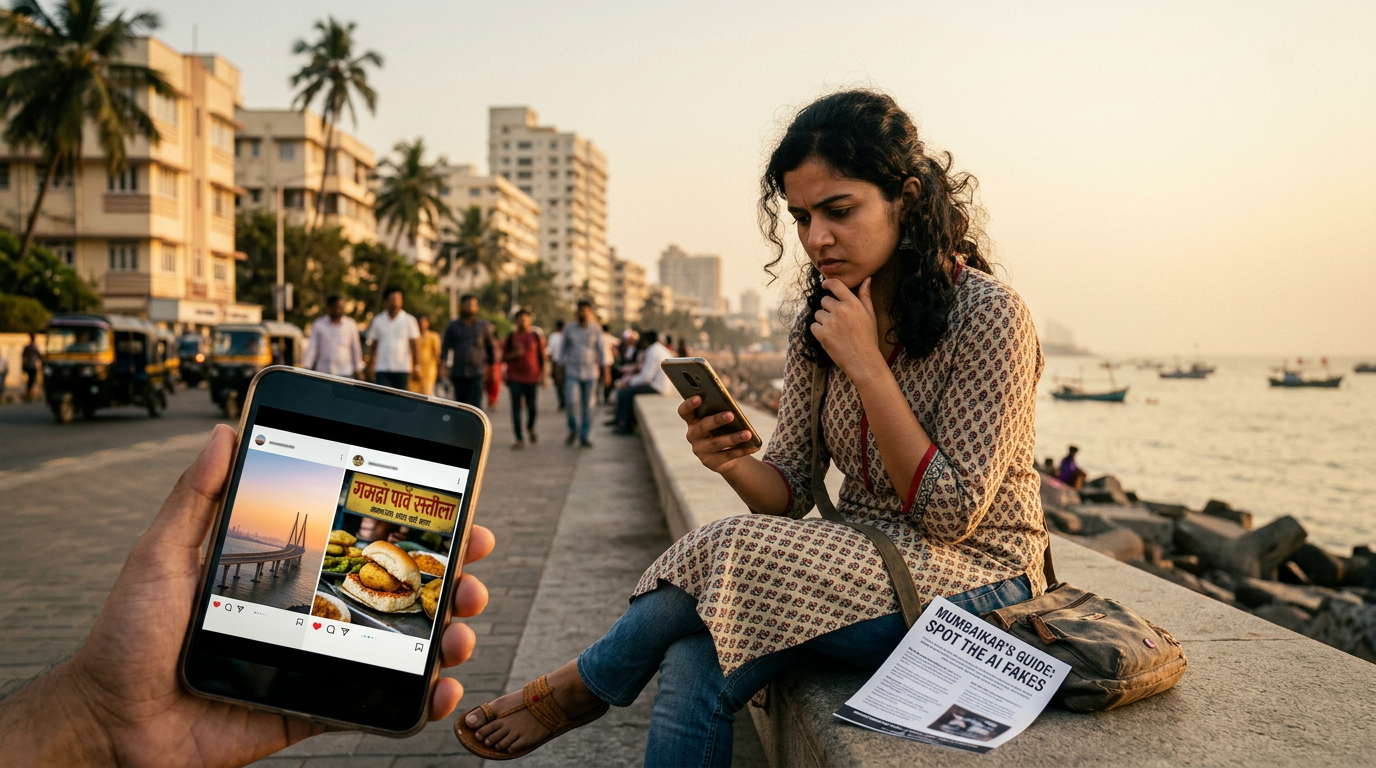
How to Spot AI Generated Images: A Mumbaikar's Guide
Think that photo of a traffic-free Sea Link is real? Our guide helps Mumbaikars learn how to spot AI generated images, from fake real estate to uncanny food pics.