
How to Spot AI Generated Images: A Mumbaikar's Guide
Think that photo of a traffic-free Sea Link is real? Our guide helps Mumbaikars learn how to spot AI generated images, from fake real estate to uncanny food pics.
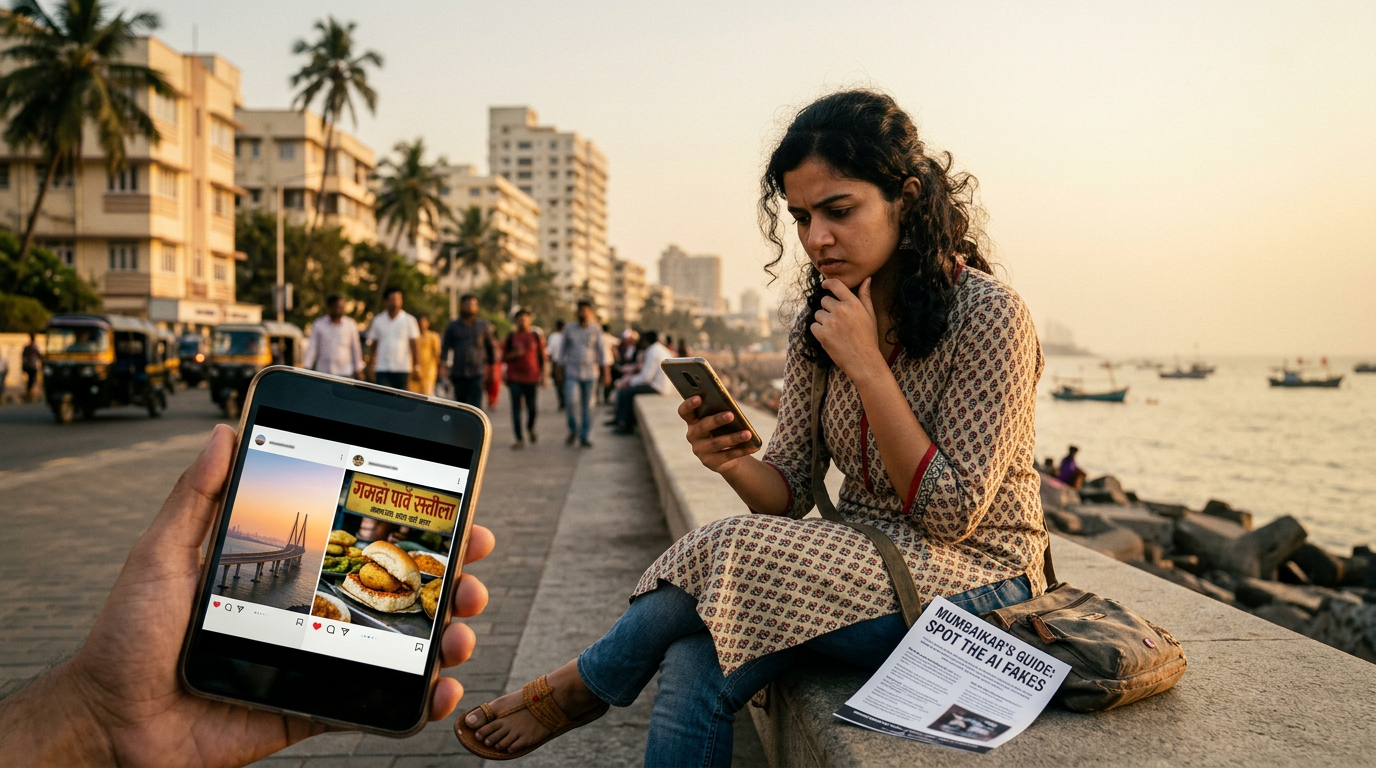
You’re scrolling through a property portal, and you find it: a stunning, sea-facing 3BHK in Powai. The rent is surprisingly reasonable, the furniture is chic, and the balcony view of the water is breathtaking. But wait... Powai has a lake, not the Arabian Sea. The reflection in the window seems just a little warped. Suddenly, the dream apartment feels like a digital mirage. As artificial intelligence becomes more sophisticated, learning how to spot AI generated images is no longer just a tech hobby. For Mumbaikars, it's a crucial digital literacy skill to avoid scams, misinformation, and the synthetic allure of a city that doesn't quite exist.
The Uncanny Valley Hits Carter Road: Oddities in People and Faces
One of the first places AI image generators fail is with human anatomy. They can create stunningly realistic portraits, but the details often betray their non-human origin. Imagine seeing a post from a new “influencer” enjoying the sunset at Carter Road in Bandra. The photo is perfect, but look closer. AI has a notorious problem with hands.
- Fingers and Hands: You might see people with six or seven fingers, fingers that bend at unnatural angles, or hands that merge bizarrely with an object they’re holding, like a cutting chai glass.
- Eyes and Teeth: Look into the eyes. AI-generated people often have a vacant, glassy stare. Their eyes might be perfectly symmetrical, or the reflections (specular highlights) in each eye won't match the light source. Similarly, teeth can be a giveaway – sometimes appearing as a single, unnaturally uniform strip rather than individual teeth.
- Ears and Hair: Ears are complex structures. AI can render them as blurry, malformed shapes, or with earrings that seem fused to the earlobe. Hair is another challenge. While it can look great from a distance, zooming in might reveal strands that behave illogically, disappearing into the skin or having a strange, waxy texture.
Next time you see a picture of a glamorous crowd supposedly outside a hotspot in Juhu or a busy group enjoying street food in Chembur, take a moment to scan the people in the background. AI often populates scenes with these subtly flawed digital extras. The main subject might be flawless, but the crowd can be a goldmine of anatomical impossibilities, a clear sign that the entire scene was cooked up by an algorithm.
Context is King: Illogical Scenes and Impossible Geography
As Mumbaikars, we have a powerful tool for spotting fakes: our deep, intrinsic knowledge of the city. AI can create a picture of a landmark, but it often gets the context hilariously wrong. This is where your local expertise becomes a superpower. Think about the absurdities that an AI, which lacks real-world understanding, might generate.
When the Location Doesn't Add Up
We started with the impossible “sea-facing” apartment in Powai. This is a classic example. An AI doesn't understand that Powai is inland. It just knows “Mumbai,” “apartment,” and “water view” are often linked. You might see other geographical blunders:
- A photo of the Bandra-Worli Sea Link with the Gateway of India visible in the immediate background.
- Pictures of lush, rolling hills supposedly taken from a flat in Andheri East.
- A pristine, empty Mumbai Local train carriage at 8:30 AM on a weekday. The ultimate fantasy, and a dead giveaway.
These errors are glaring to anyone who has navigated the city's sprawl. An AI might also create architectural impossibilities. Imagine a photo of Chhatrapati Shivaji Maharaj Terminus (CSMT) but with Gothic spires that look more like a European cathedral, or a real estate listing for a new high-rise in Vashi where the balconies seem to defy gravity. The lighting might also be a clue. A picture of Marine Drive at noon with long, dramatic evening shadows is an instant red flag. The sun’s position is a law of physics that AI still struggles to obey consistently.
Garbled Text and Warped Patterns: The Devil in the Details
While AI has become incredibly proficient at creating photorealistic surfaces and textures, it consistently fumbles two key areas: text and complex, repeating patterns. This vulnerability provides a reliable way to identify a synthetic image, especially in a city as visually dense as Mumbai.
Consider the endless posters and banners that line our streets, from movie promotions in Bandra to local Ganesh Mandal announcements in Lalbaug. An AI attempting to replicate such a scene will often generate text that is pure gibberish. It looks like a real language from a distance, but upon inspection, the characters are warped, nonsensical symbols. You might see a shop sign on a street in Dadar where the Marathi script devolves into a series of meaningless loops and lines. A fake event poster for a concert at the Jio World Centre in BKC could feature English text where letters are misshapen, fused together, or simply don't form coherent words. This is a tell-tale sign that you’re not looking at a photograph.
The Unraveling Saree
Patterns are another weak point. Think of the intricate designs on a Paithani saree you might see at a shop in Thane, or the block-printed fabrics on Colaba Causeway. An AI can replicate the general idea of the pattern, but it struggles with consistency and logic. You might find a pattern that starts strong but then dissolves into a blurry mess, or one where the design wraps around a fold of fabric in a physically impossible way. Look for inconsistencies in geometric tiles on a floor, the weave of a basket, or the detailed latticework (jaali) on a heritage building. Where a human artist or a camera would capture consistency, an AI often introduces subtle (or not-so-subtle) chaos and distortion.
That Vada Pav Looks Too Perfect: Spotting Fakes in Food Photography
Mumbai runs on its street food. From the vada pav at Dadar station to the pav bhaji at Juhu Beach, we know what real, delicious food looks like. It’s often a bit messy, gloriously imperfect, and served with a certain organised chaos. This is where AI-generated food imagery often feels sterile and unconvincing. Restaurants and cloud kitchens, especially new or dubious ones on platforms like Zomato and Swiggy, might use AI to create tempting but fake photos of their offerings.
"The perfect, symmetrical gloss on a plate of food, the complete absence of a single stray drop of chutney – these are often hallmarks of an AI chef. Real food, especially the kind we love in Mumbai, has character. AI food has only pixels."
Here’s what to look for when you're browsing for your next meal delivery from your home in Belapur or your office in Lower Parel:
- Unnatural Perfection: Is every grain of rice on the biryani perfectly separate? Does the vada pav have a flawless, spherical shape with no cracks? Real food has imperfections. AI food looks like a 3D model.
- Weird Physics: Look at the steam rising from a bowl of soup or a cup of chai. AI-generated steam can look more like solid smoke or a blurry smudge. Sauces and gravies might have a plastic-like sheen or defy gravity in how they coat the food.
- Context-Free Setting: The food might be sitting on a generic, textureless background that doesn't look like any real restaurant table or kitchen counter in Mumbai. The lighting is often too perfect, like a studio shot for a product that doesn’t exist.
Before you get excited about a new "authentic Malvani" kitchen that just popped up in your area, scrutinize the photos. If they look less like something from Gajalee and more like a stock photo from a parallel universe, it might be best to stick with your trusted local joints. [INTERNAL_LINK: Best Food Delivery Services in Navi Mumbai]
Real Estate Red Flags: The AI-Generated Dream Home Scam
The Mumbai Metropolitan Region's real estate market is notoriously competitive and, unfortunately, a fertile ground for scams. AI image generation has supercharged this, allowing fraudsters to create listings for apartments that don't exist. This is especially prevalent for upcoming areas in Navi Mumbai like Kharghar, Ulwe, and Panvel, where potential buyers or renters may be less familiar with the specifics of the area.
Imagine you're looking for a rental in Thane. You see an ad for a spacious, fully-furnished 2BHK for a price that seems too good to be true—say, ₹25,000 a month. The photos are beautiful, showing clean lines, modern furniture, and great lighting. This is where you need to become a detective.
How to Spot a Fake Listing:
- Check for Inconsistent Lighting: Look at the shadows. Does the light coming from the window create shadows that are consistent with the light from the ceiling lamps? AI often messes this up, creating multiple light sources that don't make sense.
- Analyse the Furniture: Does the furniture look like it belongs in the room? Sometimes the perspective is slightly off. A chair might seem too small for a table, or the leg of a sofa might blend into the floor. Look for warped lines in furniture or walls.
- Scrutinize Reflections: Windows, mirrors, and glossy surfaces are your best friends. A reflection in a wardrobe mirror might show a completely different room or just a blurry void. The view from the window might be a generic stock image of a forest when the building is supposedly in the middle of a dense area like Kandivali.
- Question Impossible Amenities: A listing for a small apartment in a crowded part of Borivali that boasts a massive private garden or an Olympic-sized swimming pool on the balcony is almost certainly using AI-generated or heavily manipulated imagery.
Before you even think about paying a deposit for a property you've only seen online, apply this critical lens. Always insist on a physical or live video tour. If the 'broker' makes excuses, it's a giant red flag. [INTERNAL_LINK: Guide to Renting in Mumbai Without a Broker]
Your Digital Toolkit: Practical Steps for Verification
Visual inspection is powerful, but sometimes you need to bring in technology to fight technology. When your gut tells you an image of a new development in Panvel or a political rally in South Mumbai seems off, a few simple tools can help you confirm your suspicions.
Here is a step-by-step process you can follow:
- Start with a Reverse Image Search: This is the simplest first step. Right-click the image and select "Search image with Google" (or use services like TinEye or Yandex). If the image is a known fake, a stock photo, or has been used in other unrelated contexts, this will often reveal it. You might find your "unique Kharghar apartment" photo is actually from a design catalogue in another country.
- Look for the Source: Where did the image come from? Is it from a reputable news source or a verified social media account? Or is it from an anonymous account with zero followers that was created yesterday? The source provides crucial context. Be wary of images shared widely on WhatsApp without any attribution.
- Use AI Detection Tools: Several websites and tools are designed specifically to analyze images and determine the probability that they were AI-generated. Tools like "AI or Not" or "Hugging Face" have detectors you can use. They are not foolproof, but they analyze the image for digital fingerprints, artifacts, and statistical patterns common in AI outputs.
- Check the Metadata (EXIF Data): While often stripped by social media, original image files contain metadata. This can tell you what camera was used, the date and time it was taken, and even GPS coordinates. The absence of this data isn't proof of AI, but its presence can prove authenticity. A photo of a monsoon flood supposedly from this morning that has a timestamp from 2018 is clearly being misrepresented.
Combining these techniques gives you a robust framework for verification. It’s about moving from passive consumption to active investigation, a necessary skill in today’s information ecosystem.
Why This Matters for Every Mumbaikar
Learning to spot AI-generated images goes beyond just avoiding a bad rental deal or laughing at a six-fingered tourist. It's about protecting yourself, your finances, and your understanding of the world. In a city as dynamic and sometimes chaotic as Mumbai, misinformation can spread like wildfire, with tangible consequences.
Think about the potential for misuse. Fake advertisements for products using AI images of Bollywood stars can lead to financial loss. Digitally created images of civic unrest in one part of the city could be used to incite panic or hatred. During election season, AI could generate images of political candidates in compromising or fabricated situations to sway public opinion. Imagine a fake BMC notice about a planned water cut or a new property tax, complete with a realistic-looking stamp, circulating on WhatsApp. The potential for disruption is enormous.
By honing these identification skills, you are building a critical layer of digital defense. You become a more informed consumer, a more discerning citizen, and a more reliable source of information for your friends and family. When your aunt forwards a message about a miraculous new cure with an unbelievable photo, or your friend shares a picture of a "secret, untouched beach" just an hour from Mumbai that looks suspiciously like Thailand, you can be the voice of reason. You can explain why the image looks fake, show them the signs, and stop the spread of misinformation in its tracks. It's about taking responsibility for the information we consume and share, ensuring our digital conversations are grounded in the reality of our shared city.
The digital version of Mumbai is becoming as layered and complex as the physical city itself. By learning to distinguish between the real and the synthetic, we ensure we remain grounded in the authentic, vibrant, and perfectly imperfect city we call home. Stay curious, stay critical, and don't believe every perfect sunset you see. After all, a little bit of traffic on the Sea Link is just a sign that it’s real.
Keep reading
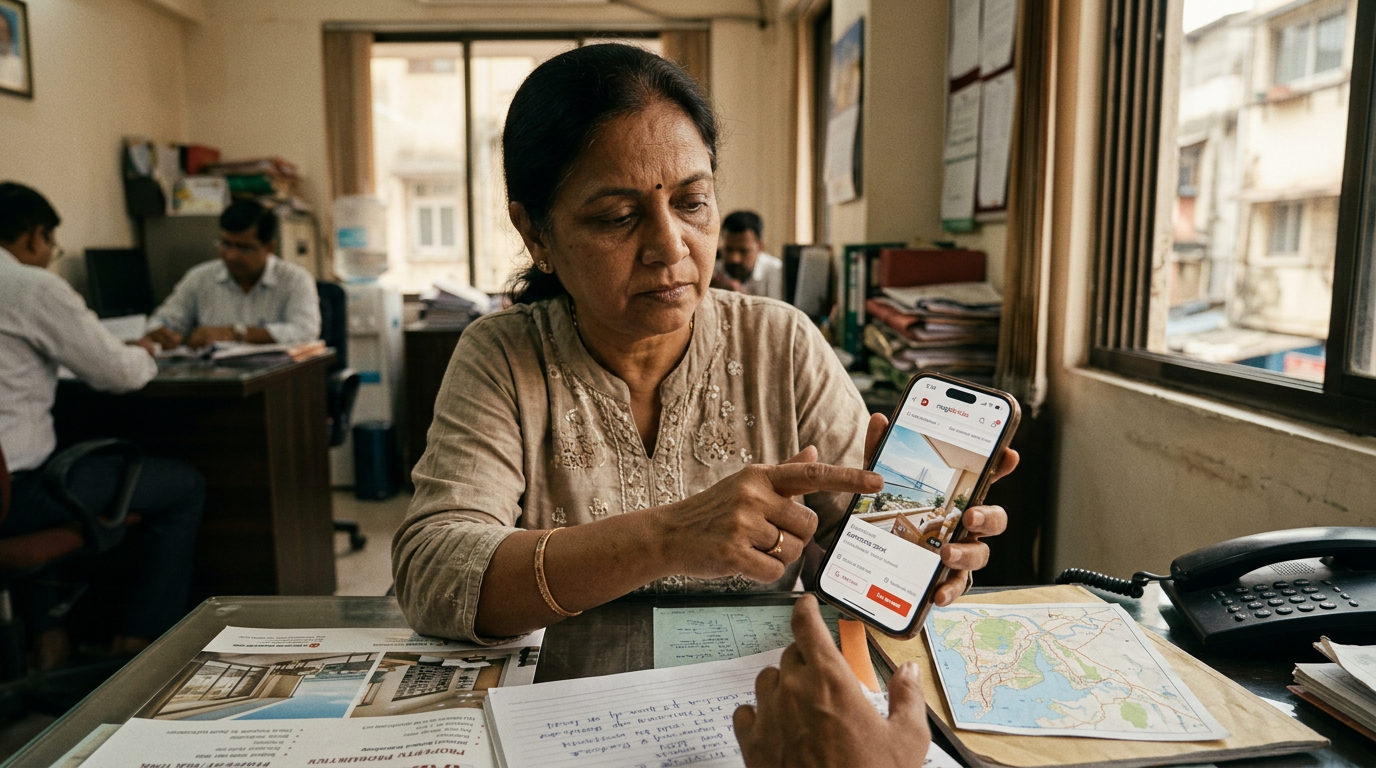
How to Spot AI Generated Images: A Mumbai Guide
From fake Powai apartment listings to too-perfect food photos from a Bandra cafe, AI fakes are everywhere. Here’s your guide on how to spot AI generated images in Mumbai.
Mumbai's Guide to the Best AI Productivity Tools for Professionals
In Mumbai's relentless hustle, staying ahead is key. This guide reveals the best AI productivity tools to automate tasks, manage projects, and reclaim your time, whether you're in BKC or Vashi.
Best AI Productivity Tools for Mumbai & Navi Mumbai Professionals
Tired of the Mumbai grind? We review the best AI productivity tools that can help professionals from Bandra to Belapur save time, streamline tasks, and conquer their to-do lists.