How to Spot AI Generated Images: A Mumbai Guide
From six-fingered tourists at the Gateway of India to flawless vada pavs, our Mumbai-centric guide teaches you how to spot AI generated images and navigate our new digital reality.
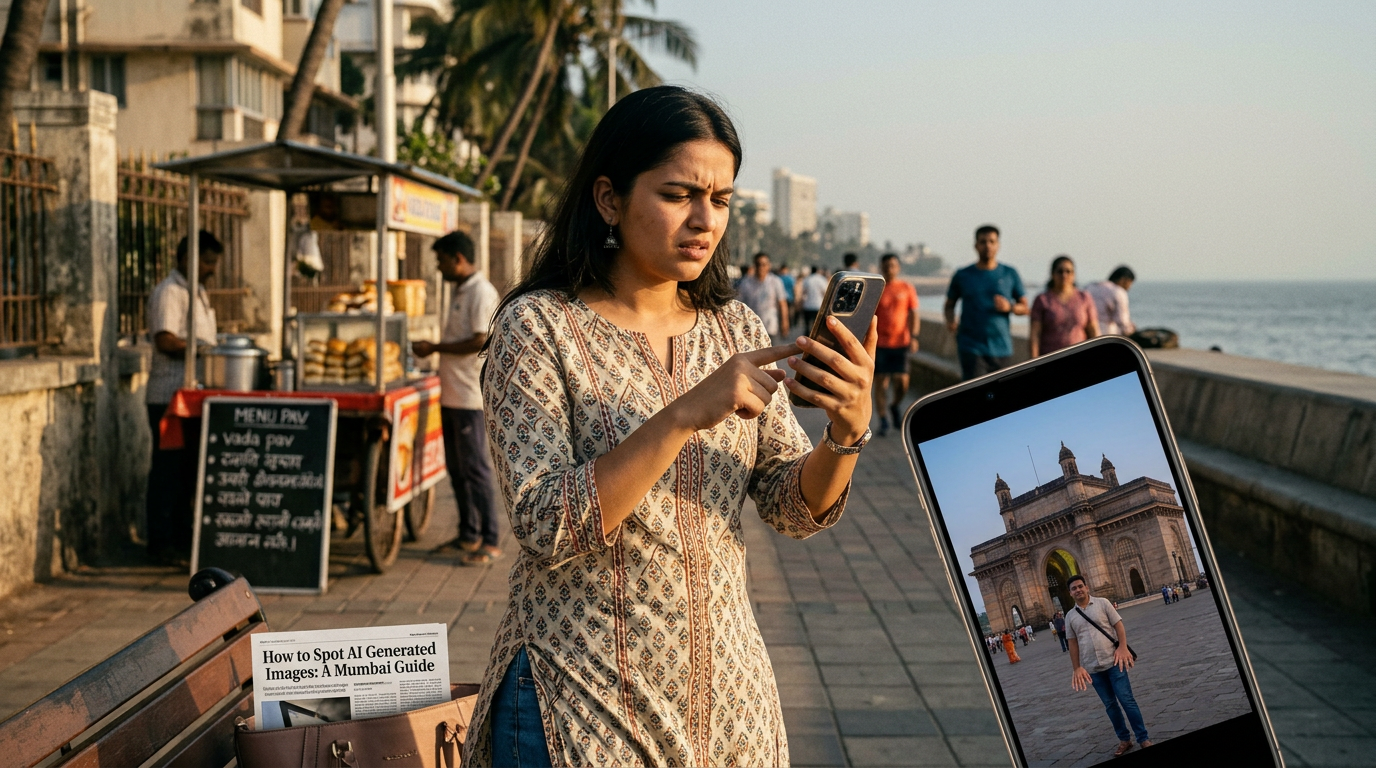
You’re scrolling through your feed and a stunning photo stops you. It’s the Bandra-Worli Sea Link, but not as you know it. The sky is a swirl of nebulae, and sleek, futuristic vehicles hover above the traffic. It's breathtaking. Yet, the part of your brain that’s been stuck in a jam on that very bridge feels a slight twinge of suspicion. This is the new reality of our digital lives in Mumbai. As artificial intelligence becomes more sophisticated, learning to spot AI generated images is no longer a niche skill for techies; it's an essential tool for every Mumbaikar navigating a world of deepfakes and digital art. From WhatsApp forwards to Instagram influencers, distinguishing fact from fiction is key.
The Uncanny Valley Arrives at Carter Road: Check the Hands
One of the most reliable giveaways for AI-generated images, especially those featuring people, lies in the details of human anatomy. AI models, for all their power, consistently struggle with hands, feet, and teeth. Think of it as the uncanny valley hitting the Carter Road promenade. You might see a glamorous image promoting a new café in Bandra, showing a group of friends laughing. At first glance, it looks real. But look closer. One person might have six fingers. Another’s hand might have fingers that are unnaturally long and rubbery, or they might seem to merge with the coffee cup they’re holding. These are classic AI artefacts.
This isn't limited to hands. Pay attention to other complex details:
- Teeth: AI often generates teeth that are too perfect, too numerous, or oddly spaced, like a glistening, uniform wall rather than individual teeth.
- Ears and Earrings: Look at the ears. Are the lobes strangely shaped? Do earrings match, or does one look like a metallic blob while the other is perfectly defined? AI often fails at symmetry and consistency in accessories.
- Proportions: Sometimes the overall proportions are just slightly off. A person’s head might be too small for their body, or their limbs might be at an impossible angle. It’s a subtle feeling of wrongness that your brain picks up on even if you can't immediately place it.
The next time you see a picture of an impossibly chic crowd at a rooftop bar in Andheri, take a moment to play detective. Count the fingers. It’s often the fastest way to confirm your suspicions.
Glitches in the Mumbai Matrix: When Architecture Goes Wrong
Beyond people, AI often falters when rendering complex backgrounds and architecture. Our city is a beautiful mess of colonial-era buildings, modern glass towers, and everything in between. This complexity is hard for an AI to replicate perfectly. Look for glitches in this Mumbai matrix. For example, an image of the Chhatrapati Shivaji Maharaj Terminus (CSMT) might capture the overall grandeur, but upon closer inspection, you could find architectural elements that melt into each other. A detailed stone carving might suddenly lose all definition and become a smooth, blurry patch. Intricate patterns may repeat unnaturally, like a copy-paste error on a historical monument.
Reflections and shadows are another area where AI stumbles. Imagine a serene image of Powai Lake. The Hiranandani skyline is in the background, but the reflection in the water is distorted, showing a different set of buildings or a sky that doesn’t match. Or consider a photo of a bustling lane in Colaba; a streetlight might cast a shadow in the wrong direction, or a person walking by might have no shadow at all. Our brains are hardwired to understand how light works, and these inconsistencies create a jarring effect. These are not Photoshop errors; they are fundamental misunderstandings by the AI about how the physical world operates. So, when you see a picture of a landmark, don't just look at the subject; scrutinize the world it inhabits.
The Gibberish on the Menu: AI's Struggle with Text
This is perhaps the simplest and most definitive test. AI image generators are notoriously bad at writing. They don't understand letters and words as concepts; they see them as shapes to be painted. The result is often text that looks plausible from a distance but is complete gibberish up close. You might see a hyper-realistic image of a street food vendor in Ghatkopar. The cart, the crowd, the steam rising from the tava—it all looks authentic. But zoom in on the sign. Instead of 'Pani Puri', it might say 'Panu Purri' with warped, half-formed letters. This is a dead giveaway.
This issue is everywhere once you start looking for it:
- A fake menu for a South Indian restaurant in Matunga where 'Masala Dosa' becomes a jumble of unreadable characters.
- A promotional poster for a concert at the Jio World Centre with a nonsensical band name and date.
- The license plate on a kaali-peeli taxi that contains strange symbols instead of letters and numbers.
- A book cover in an image of a person reading at a café in Fort, where the title is an unreadable smudge.
Because AI 'draws' what it thinks text looks like, the result is a dream-like approximation of language. If the text in an image is sharp, clear, and perfectly readable, it’s more likely to be real (or have had text added by a human designer later). If it looks like you're trying to read a sign in a dream, you're almost certainly looking at an AI creation.
The 'Too Perfect' Problem: An Unnaturally Clean Vada Pav
Mumbai is vibrant, chaotic, and beautifully imperfect. AI, on the other hand, often has a bias towards perfection and smoothness. This can lead to images that feel sterile and artificial. Consider an image of a vada pav. A real vada pav has character: the besan coating is uneven, the pav is slightly squashed, and there might be a stray drop of chutney. An AI-generated vada pav might be perfectly spherical, with a flawless, textureless coating and a bun that looks like a 3D render. It lacks the soul of the real thing.
This extends to entire scenes. An AI image of Juhu Beach might show pristine, golden sand without a single piece of litter, no stray dogs, and perfectly uniform waves. A picture of Dadar flower market might be filled with blossoms that have no blemishes or wilting petals. Reality is messy. Digital creations are often too clean. Look for a lack of natural texture. Skin might look airbrushed and poreless, a brick wall might lack grit and variation, and clothing might have no natural folds or creases. If an image looks too good to be true, it probably is. This aesthetic of unnatural perfection is a subtle but powerful clue that a machine, not a camera, was the artist.
Your Own Cyber Detective: Using Tools to Verify Images
Beyond visual inspection, you can use a few simple digital tools to become your own cyber detective, right from your home in Thane or Panvel. These methods can provide more definitive proof when your eyes aren't quite sure.
- Conduct a Reverse Image Search: This is your most powerful weapon. Services like Google Lens and TinEye allow you to upload or paste the URL of an image. The search will show you where else that image has appeared online. If it shows up on AI art platforms like ArtStation or DeviantArt with tags like 'Midjourney' or 'DALL-E', you have your answer. It can also reveal if a real photo has been digitally altered.
- Zoom In and Scrutinize the Details: We call this pixel-peeping. Download the highest resolution version of the image you can find and zoom right in. Look for the strange artifacts we've discussed, like blended textures where there should be sharp lines, or weird patterns in areas that should be a solid colour or a natural texture like wood grain or fabric.
- Check the Source and its History: Who posted the image? Is it a reputable news organization, a professional photographer with a history of real work, or a new, anonymous account? Many accounts that exclusively post AI art have a certain look: a feed full of fantastical, high-gloss images, often with similar themes and no behind-the-scenes content.
- Look for Missing Data: A real photograph taken on a phone or camera contains hidden information called EXIF data. This includes the camera model, shutter speed, ISO, and sometimes even GPS coordinates. AI-generated images have none of this. While the absence of EXIF data isn't definitive proof (it can be stripped out), its presence is a strong indicator of an authentic photograph. You can use an online EXIF viewer to check. [INTERNAL_LINK: cybersecurity tips for Mumbaikars]
Context is King: Why is a Snow-Covered Vashi Trending?
Perhaps the most important tool you have is your own knowledge and critical thinking. The ultimate giveaway is often context. An image showing heavy snowfall on the Vashi bridge is visually striking but geographically impossible. A photo of a lion casually strolling down Marine Drive would be international news, not just a random post on social media. Before you even look for six-fingered hands or garbled text, ask yourself a simple question: does this make sense in the Mumbai I know? Often, the answer is a resounding no. These images are created for engagement, to spread misinformation, or simply as a creative exercise. Understanding the 'why' can help you spot the 'what'.
"The most powerful tool against misinformation isn't software; it's the critical thinking of the user. Before you share that 'unbelievable' photo of a tiger roaming through Aarey Colony, ask yourself: does this make sense? Who benefits from me believing this? In a city as media-saturated as Mumbai, that pause for thought is your best defense."
This applies especially to deepfakes involving local politicians or Bollywood celebrities. If you see a video of a famous actor endorsing a questionable financial scheme in a stilted, emotionless voice, be extremely skeptical. Check reputable news sources. Has anyone else reported on this? The context—or lack thereof—is your final and most powerful filter against deception. [INTERNAL_LINK: navigating deepfakes in India]
From Deception to Creation: AI Art in Navi Mumbai's Creative Hubs
It's important to remember that AI image generation isn't inherently bad. It's a powerful new tool for creativity. Across the Mumbai Metropolitan Region, especially in the growing creative hubs of Navi Mumbai, artists and designers are embracing it. A graphic designer in a Belapur studio might use Midjourney to rapidly prototype logo ideas for a new client. An architect in Kharghar could use an AI tool to generate conceptual visualizations for a new building project, bringing their ideas to life in minutes instead of days. Local artists are creating stunning, surrealist works that blend familiar Mumbai scenes with fantasy elements, sharing them online and even showcasing them in digital galleries.
The key distinction is intent. When an artist clearly labels their work as 'AI-generated' or 'AI-assisted', they are using it as a medium for expression. The problem arises when these images are presented as real photographs with the intent to deceive, whether for a scam, a political agenda, or simple online clout. By learning to spot the tell-tale signs of AI, we are not dismissing the technology as a whole. Instead, we are becoming more discerning consumers of media, able to appreciate the art while rejecting the deception. It's about celebrating the creativity of a digital artist in Vashi while simultaneously questioning the authenticity of a suspicious WhatsApp forward. [INTERNAL_LINK: best photography spots in Mumbai]
Become a Smarter Digital Mumbaikar
Navigating our shared digital space requires a new layer of media literacy. The lines between real and artificial will only continue to blur. But by equipping yourself with a few key observational skills, you can confidently parse the images that fill your screen. Remember the core checks: look for bizarre hands and features, scrutinize the background for architectural or reflection errors, check for nonsensical text, be wary of unnatural perfection, and, most importantly, always consider the context. Is a penguin really taking a dip at Girgaon Chowpatty? Probably not. Being a savvy digital citizen means being a skeptical one. It means taking that extra second before you hit 'share' on that incredible-but-unbelievable image. By doing so, you not only protect yourself from misinformation but also help to create a more informed and truthful online environment for everyone in our bustling metropolis. What's the most convincing (or ridiculous) AI image you've seen that was supposedly from Mumbai? Share it in the comments below and let's practice our new detective skills! Don't forget to share this guide with friends and family to help them stay sharp.
Keep reading
Best AI Productivity Tools for a Mumbaikar's Hectic Life
Struggling with the Mumbai hustle? We review the best AI productivity tools that help you conquer your to-do list, manage your inbox, and reclaim your time in the Maximum City.
How to Spot AI-Generated Images: A Mumbai Local's Guide
A viral image shows elephants strolling through Powai. Is it real? As AI image generators become more powerful, it's getting harder to tell. Here's your essential guide for spotting fakes in Mumbai.
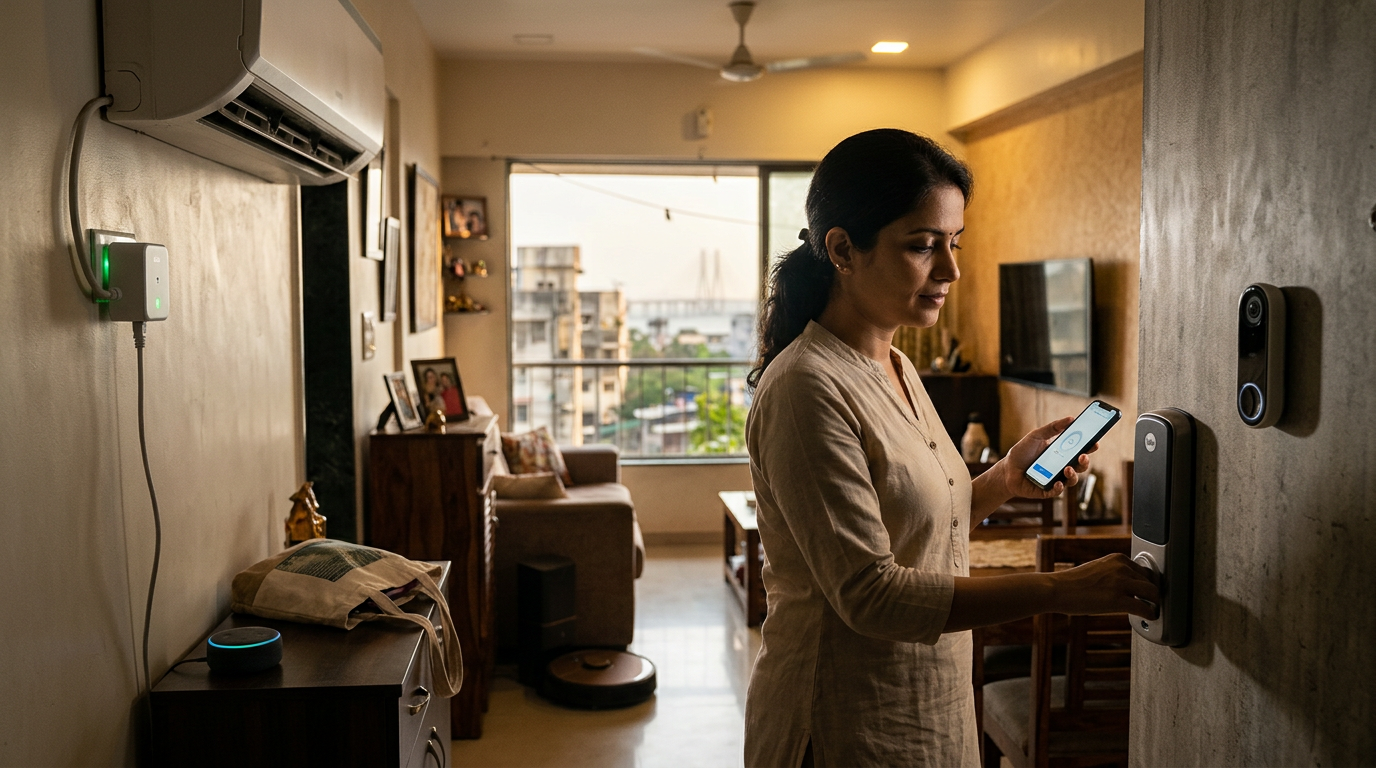
Smart Home Devices Worth Buying for Your Mumbai Flat
Tired of Mumbai's heat and security woes? We break down the smart home devices worth buying, from smart plugs for your AC in Bandra to video doorbells for your Powai flat.