
How AI Is Reshaping Creative Industries Worldwide
From anime studios in Tokyo to music houses in Lagos, algorithmic systems are transforming artistic workflows. Here is how AI is reshaping creative industries.
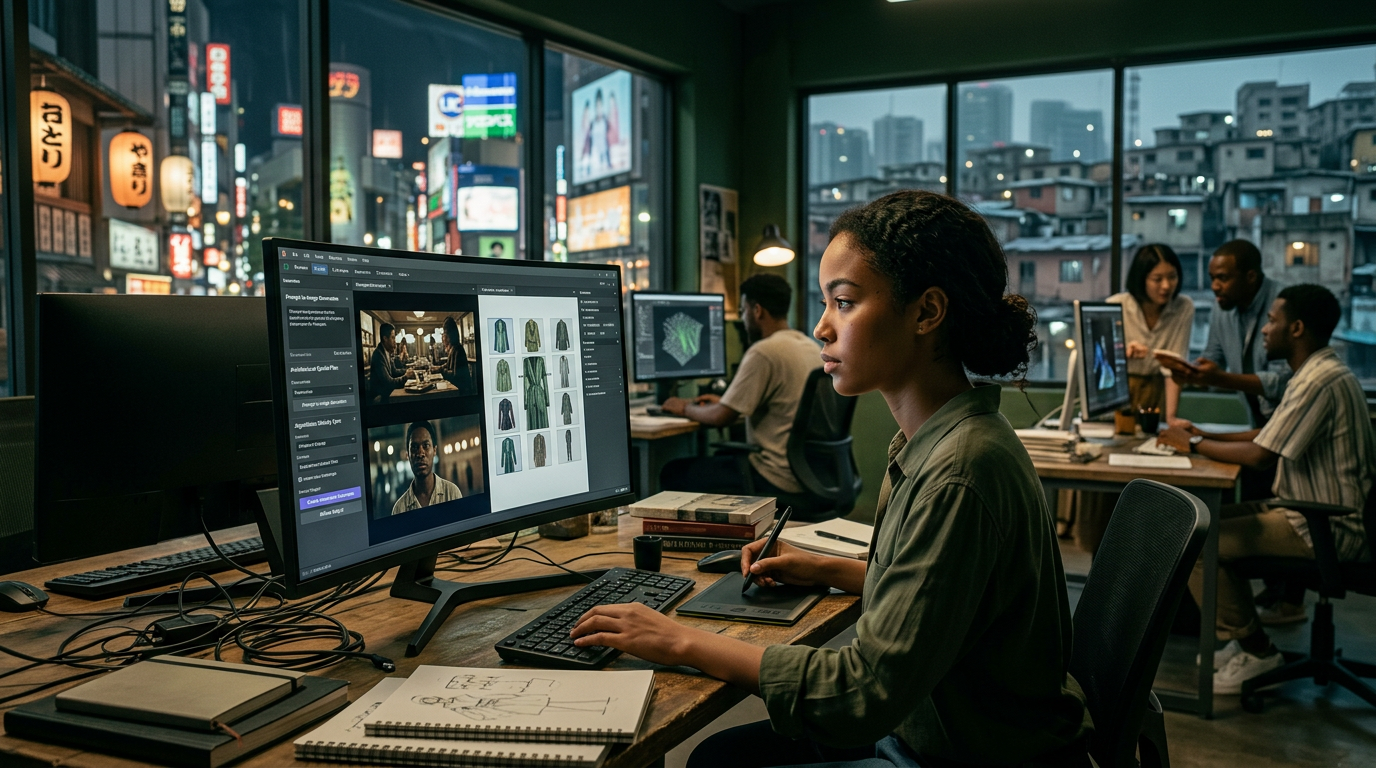
Walk into a post-production suite in Burbank, a sound engineering booth in Seoul, or an architectural studio in São Paulo, and you will notice an unmistakable shift in atmosphere. Creatives no longer stare at blank screens waiting for inspiration; instead, they interrogate prompts, curate synthetic variations, and refine mathematical approximations of style. Understanding how ai is reshaping creative industries requires looking past the breathless tech headlines to observe what practitioners on six continents actually do with these tools every day. Far from replacing human ingenuity outright, machine intelligence is rewiring the logistics of imagination.
Cinematic Storytelling: From Hollywood to Nollywood
Film production has historically carried one of the highest barriers to entry in creative media, dictated by the sheer cost of cameras, lighting rigs, visual effects rendering, and extensive crews. Generative models and neural rendering pipelines are dismantling those capital barriers, transforming film finance and production workflows from Los Angeles to Lagos.
In Nigeria's prolific Nollywood, directors operate under intense turnaround times and tight budgets. Independent filmmakers across West Africa are now deploying generative background plates, synthetic crowds, and automated color grading to achieve scale previously reserved for nine-figure studio releases. Rather than spending weeks building physical period sets or renting prohibitively expensive location permits, production designers generate high-fidelity background plates that integrate seamlessly with green-screen footage.
Meanwhile, Hollywood studios are concentrating on dynamic localization. The traditional dubbing process—notoriously detached and visually jarring—is giving way to neural video synthesis. AI systems now alter an actor's lip movements in post-production to match translated dialogue across Spanish, Mandarin, or French releases, preserving emotional nuance while eliminating the cognitive dissonance of mismatched audio. As explored in our analysis of [INTERNAL_LINK: generative video production trends], the real revolution lies not in fully synthetic feature films, but in rendering physical production radically more agile.
"We used to spend forty percent of our post-production schedule cleaning up wire rigs, rotoscoping frame by frame, and adjusting lighting mismatches. Neural networks have turned those weeks of drudgery into afternoon tasks, returning our focus entirely to pacing and performance."
The Sonic Renaissance: Algorithmic Composition Across Continents
The music industry has weathered technological disruption before, from multitrack tape to MIDI and digital streaming. Yet the integration of neural audio synthesis represents a fundamental change in how melodies, harmonies, and arrangements originate. Rather than replacing the musician, machine models act as tireless session players capable of exploring thousands of micro-variations on demand.
In South Korea's hyper-competitive K-pop industry, top producers rely on custom machine learning engines to identify untapped harmonic combinations and forecast auditory hooks. Production teams feed decades of global chart data into models that isolate infectious rhythmic patterns, which human composers then adapt into polished tracks. The resulting output blends algorithmic structural rigor with human emotional resonance.
On the African continent, producers of Amapiano and Afrobeats are utilizing automated stem separation and neural synthesis to sample rare, analog field recordings of traditional instruments without audio degradation. Consider how modern sonic teams deploy these tools:
- Rapid Prototyping: Songwriters generate instrumental textures and chord progressions in seconds to break creative blocks.
- Vocal Synthesis and Restoration: Producers clean damaged archive tracks or build dynamic backing harmonies using model-trained vocal profiles.
- Algorithmic Mastering: Independent artists in emerging markets achieve radio-ready dynamic range without booking expensive mastering suites in London or New York.
This democratization also sparks critical tension over copyright and vocal identity, pushing legal systems in the European Union, the United States, and East Asia to reconsider what constitutes fair use when an algorithm learns a singer's distinct vocal timbre.
Visual Arts and Illustration: Human Vision Meets Machine Precision
Perhaps nowhere is the impact of computational tools more visible than in illustration, concept art, and fine arts. In Tokyo, animation studios facing severe labor shortages and punishing production schedules are turning to neural drawing assistants to handle intermediate frame generation (in-betweening) and background painting. Japanese animators use custom-trained models based strictly on their studio's historical archives to draft complex urban backdrops, freeing senior artists to focus on character expressive nuance and climatic set pieces.
Across Latin America and Eastern Europe, freelance digital illustrators are shifting their identity from manual draftspersons to art directors. The initial conceptual phase—once a grueling cycle of pencil sketches and mood boards—now happens collaboratively with generative diffusion systems. An illustrator might produce twenty composition variants in an hour, select the strongest structural element from each, and composite them manually in digital editing software.
Far from devaluing human craft, this workflow has elevated the importance of taste, curation, and historical visual literacy. An artist who understands baroque chiaroscuro, Bauhaus typography, and mid-century modern composition can steer generative software toward sophisticated outcomes, whereas an unskilled user produces generic digital noise. For a deeper breakdown of workflow integration, review our guide on [INTERNAL_LINK: prompt engineering for creative professionals].
Architecture and Spatial Design: Generative Urbanism
Beyond two-dimensional canvases and temporal media, computational systems are fundamentally altering the built environment. Architecture firms from London to Singapore are deploying parametric and generative design models to solve intricate structural, thermal, and social challenges before breaking ground.
Generative software optimizes structural skeletons to minimize raw material usage without sacrificing structural integrity. By mimicking natural growth patterns found in bone density and tree branches, these programs generate organic structural supports that save significant concrete and steel, reducing the embedded carbon footprint of modern skyscrapers. In fast-growing urban centers like São Paulo and Jakarta, civic planners and architects feed demographic projections, solar radiation metrics, and wind corridor data into AI engines to plan public housing blocks that maximize natural ventilation and daylight access.
The traditional design process follows a linear path: concept sketch, client review, structural engineering analysis, and iterative revision. Generative computational pipelines collapse these distinct silos into an integrated feedback loop:
- Constraint Definition: Architects input municipal zoning restrictions, solar angles, acoustic targets, and structural loads into the modeling environment.
- Synthetic Generation: The algorithm produces hundreds of viable spatial configurations matching those exact physical parameters.
- Human Curation and Cultural Synthesis: The design team selects permutations that align with local cultural aesthetics, neighborhood character, and human scale.
- Automated Documentation: The system produces detailed construction documentation and structural load calculations instantaneously.
Haute Couture and Fast Fashion: Redefining the Runway
Fashion houses in Milan, Paris, and Shenzhen are using artificial intelligence to bridge the divide between high-concept aesthetics and industrial supply chain efficiency. Luxury ateliers leverage predictive models to analyze archival collections stretching back over a century, uncovering forgotten silhouettes, stitch patterns, and color palettes that can be reinterpreted for upcoming seasons.
Textile designers collaborate directly with image-synthesis algorithms to create complex jacquard patterns, knitwear structures, and prints that defy traditional human drafting. Instead of weaving yards of test fabric—a process that consumes significant water, dye, and yarn—design teams visualize hyper-realistic 3D fabric simulations on virtual avatars. Brands test market appeal by running digital garment showrooms long before committing physical resources to factory runs.
In the direct-to-consumer space, artificial intelligence is tackling fashion's greatest environmental crisis: unsold inventory. By analyzing real-time social engagement, regional climate deviations, and browsing micro-behaviors, fashion conglomerates can manufacture limited runs that mirror exact local demand. The creative process merges with operational logistics, making style responsive to consumer identity without the ruinous waste of mass speculation.
Publishing and Literature: The Shifting Mechanics of the Written Word
The publishing industry presents a more conservative exterior, yet underneath, linguistic algorithms are changing the editorial lifecycle. Rather than generating finished prose—which frequently reads flat, formulaic, and devoid of genuine voice—writers and editors use language models as analytical mirrors and research accelerators.
In Scandinavia, authors of Nordic noir and procedural mysteries use fine-tuned language models to maintain complex narrative timelines, map forensic continuity, and cross-reference character biographies across multi-book series. When managing dozens of locations, suspects, and clues, authors treat computational systems as hyper-competent research assistants who can identify plot discrepancies before manuscripts reach proofreaders.
Literary translation represents another area of deep transformation. Translating idioms, historical vernacular, and regional cadences between disparate languages—such as Arabic and English, or Japanese and Spanish—historically required extensive manual labor, often leaving brilliant non-Western authors unread abroad. Today, advanced contextual translation tools produce high-fidelity draft translations that capture syntactical idiosyncrasies. Human literary translators then step in not as raw typists, but as cultural polishers, fine-tuning rhythm, subtext, and emotional resonance. You can learn more about this symbiotic workflow in our feature on [INTERNAL_LINK: artificial intelligence and the future of translation].
Intellectual Property, Ethics, and the Battle for Provenance
Every major technological shift in artistic history—from the invention of photography to the rise of peer-to-peer file sharing—has triggered existential debates over ownership, fair compensation, and ethics. The current wave of generative tooling is no exception, and the legal battles unfolding today will establish the legal architecture of human culture for generations.
The primary controversy centers on training data. Massive foundational models are trained on billions of images, songs, books, and code repositories scraped from the open web, often without explicit consent, financial attribution, or royalties for the original human creators. In the European Union, regulators are responding via the Artificial Intelligence Act, enforcing strict transparency rules that require developers to publish detailed summaries of copyrighted materials used in model training. By contrast, jurisdictions like Japan have adopted more permissive legal frameworks regarding data ingestion, seeking to position their tech sectors at the forefront of algorithmic research.
Grassroots creative coalitions worldwide are organizing to establish collective bargaining agreements and secure copyright protection. Musicians in Nashville and London are campaigning for statutory personality rights to prevent synthetic voice cloning without explicit contracts. At the same time, visual artists are adopting defensive watermarking tools like Glaze and Nightshade, which subtly alter pixel arrays to prevent machine scrapers from reverse-engineering artistic styles. The resolution to these legal conflicts will not emerge from technological determinism, but through aggressive legislative debates, labor solidarity, and institutional policy updates.
The Future of Cultural Work: Augmentation Over Automation
When assessing how AI is reshaping creative industries, panic and utopian hype both obscure the practical truth. Automation threatens repetitive, low-context production tasks: basic rotoscoping, standard asset resizing, routine translation, and generic stock photography. However, the cultural value of art has never rested solely on the technical execution of pixels, paint strokes, or sound waves; it resides in the lived human context that underpins the work.
Audiences care about music because it reflects human heartbreak, communal celebration, or political resistance. Readers love novels because they reveal the interior psychology of conscious beings experiencing grief, passion, and mortality. Architecture moves us because it responds to communal rituals and historical geography. Technology is an extraordinary amplifier of technique, but technique without human perspective produces hollow commodities.
The creative leaders of the next decade will not be those who stubbornly ignore computational tools, nor will they be those who hand the steering wheel entirely to autonomous code. They will be the hybrid creators: the animators who direct algorithms like lighting crews, the composers who treat neural audio as a radical new synthesizer, and the writers who use language models to push beyond their own narrative habits. Creativity has always evolved alongside our tools. The canvas has simply broadened, and the palette now includes the computational power of the machine.
If you work in design, film, music, or writing, the imperative is clear: experiment directly with these tools today. Test their limits, critique their weaknesses, understand their legal implications, and integrate them thoughtfully into your personal creative workflow.
Keep reading
AI Regulation Europe vs United States Debate: Who Sets Global Rules?
The AI regulation Europe vs United States debate highlights two divergent visions for technology governance, setting benchmarks that impact economies worldwide.
Top AI Startups to Watch This Year: A Global Report
Who are the top AI startups to watch this year? Beyond the usual suspects, a new wave of global innovators is redefining industries. We spotlight the companies you need to know.