
Top AI Startups to Watch This Year: A Global Report
Who are the top AI startups to watch this year? Beyond the usual suspects, a new wave of global innovators is redefining industries. We spotlight the companies you need to know.
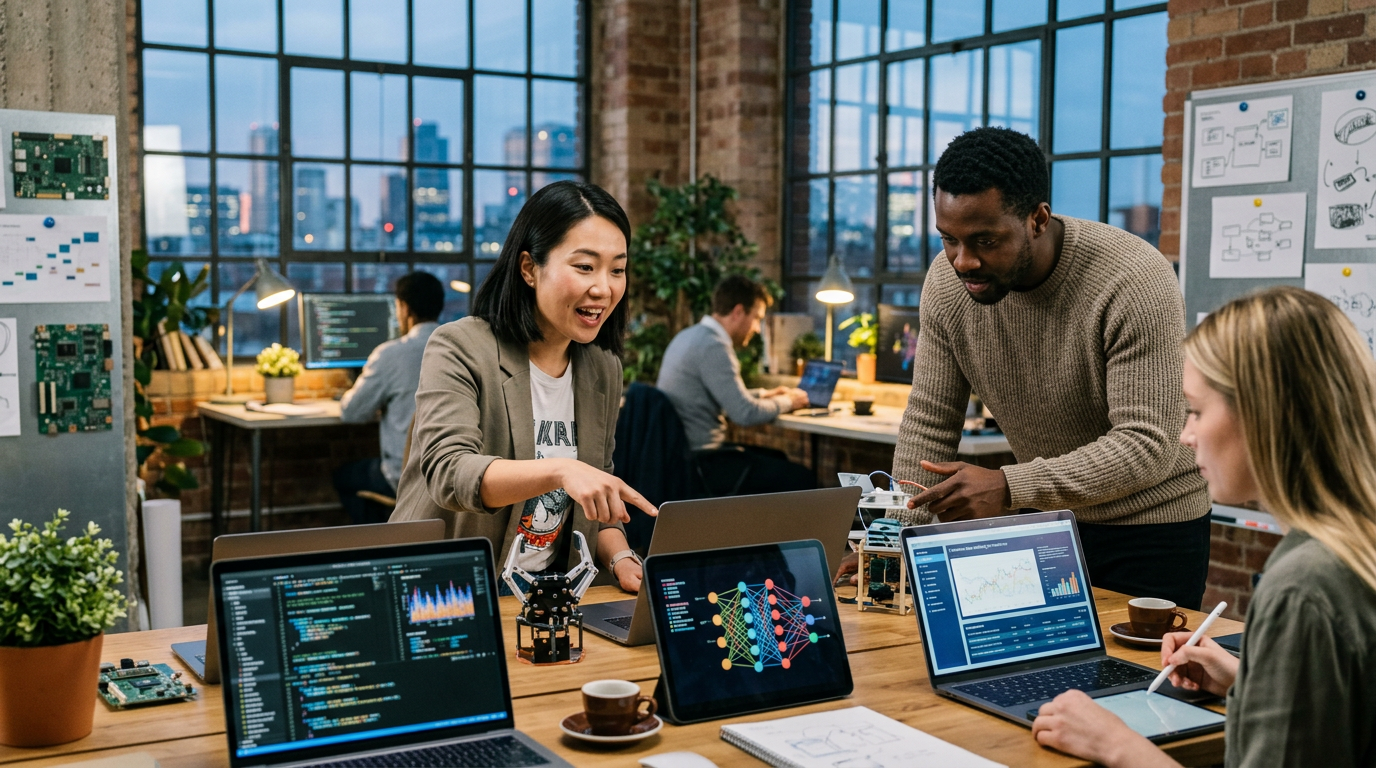
While names like OpenAI, Google DeepMind, and Anthropic dominate headlines, the real story of artificial intelligence is being written by a new class of global innovators. These companies are moving beyond general-purpose chatbots and into specialized, high-impact domains. To find the top AI startups to watch this year, you need to look beyond Silicon Valley to the tech hubs of Paris, Seoul, Tel Aviv, and beyond. This new wave is building more efficient models, tackling climate change, revolutionizing medicine, and creating the physical and digital infrastructure that will power the next decade of progress.
We’ve scanned the globe to identify the companies that are not just generating buzz, but are building sustainable businesses and solving tangible problems. From foundational model challengers in Europe to robotics powerhouses in Asia, these are the startups setting the agenda.
The New Frontier of Foundational Models
The race to build the most powerful large language models (LLMs) is far from over. While the giants invest billions, a fascinating trend is emerging: the rise of specialized and open-source model builders. These startups are proving that bigger isn’t always better, focusing instead on efficiency, transparency, and specific enterprise needs. They are challenging the notion of a one-size-fits-all model and carving out significant niches in the process. This diversification is crucial for a healthy AI ecosystem, preventing a handful of corporations from controlling the core technology.
Mistral AI (France)
Paris-based Mistral AI exploded onto the scene with a bold, open-source-first approach. Founded by alumni from Google’s DeepMind and Meta, the company champions smaller, more cost-effective models that can be fine-tuned and run anywhere, from the cloud to a local device. Their “Mixtral” series of models, which use a Mixture of Experts (MoE) architecture, have delivered performance rivaling much larger, closed-source competitors. This has made Mistral a favorite among developers and a strategic partner for companies like Microsoft, who see its potential to broaden the market for AI applications. Mistral represents Europe’s strongest contender in the foundational model space and a powerful advocate for a more open AI future. For more background on these models, check out our guide on [INTERNAL_LINK: what-is-a-foundational-model].
Cohere (Canada)
Headquartered in Toronto, Cohere has taken a different path, focusing squarely on the enterprise from day one. They provide businesses with access to high-performance models designed for real-world commercial applications like advanced search, retrieval-augmented generation (RAG), and content summarization. Their key differentiator is a focus on data privacy, security, and the ability to deploy models in a customer's own cloud environment. By prioritizing the needs of large organizations, Cohere is building the secure, scalable tools that companies require to integrate AI into their core operations, positioning itself as the go-to provider for business-critical AI.
AI for Climate Tech: A Planet-Sized Challenge
One of the most inspiring applications of artificial intelligence is in the fight against climate change. Startups around the world are leveraging AI to analyze complex environmental data, optimize energy consumption, create sustainable materials, and build a more resilient planet. These companies are using machine learning to find patterns and solutions that are simply beyond human capability, providing critical tools for decarbonization and environmental monitoring. The fusion of AI and climate tech is no longer a niche interest; it's a rapidly growing sector attracting significant investment and top talent, driven by the urgency of the climate crisis.
Planet A Foods (Germany)
Based in Munich, Planet A Foods is tackling deforestation and unethical supply chains in the food industry. Their flagship product, ChoViva, is a cocoa-free chocolate alternative made from locally sourced oats and sunflowers. The magic happens through a proprietary fermentation process, guided by AI, that replicates the complex flavors of cocoa. By using machine learning to analyze and control the fermentation, they can achieve remarkable taste consistency and scale up production sustainably. This innovative approach offers a blueprint for how AI can help create sustainable alternatives to resource-intensive agricultural products, reducing our environmental footprint one delicious bite at a time.
Overstory (Netherlands/USA)
Vegetation management is a critical but often overlooked aspect of climate resilience. Falling trees and overgrown vegetation are a primary cause of power outages and wildfires. Amsterdam-based Overstory applies computer vision to high-resolution satellite imagery to provide electric utilities with a real-time, dynamic view of vegetation risk along their power lines. Their AI platform can identify tree species, measure their height and proximity to wires, and predict growth patterns. This allows utility companies to move from a reactive, cyclical trimming schedule to a proactive, risk-based approach, improving grid reliability, preventing fires, and saving millions of dollars.
Revolutionizing Healthcare with Predictive AI
The impact of AI on healthcare and biotechnology is profound, accelerating the pace of discovery and paving the way for truly personalized medicine. From identifying new drug candidates in days instead of years to diagnosing diseases earlier and with greater accuracy, startups are applying AI to solve some of the most complex biological puzzles. This field is a hotbed of innovation, where deep learning models are becoming indispensable tools for researchers, doctors, and pharmaceutical companies. The potential to extend human healthspan and treat previously incurable diseases is driving immense investment and hope.
"Biology and technology are converging. We're using machines to understand the complexity of life, turning drug discovery from a process of serendipity into one of engineering. It's a fundamental shift in how we approach medicine."
Recursion Pharmaceuticals (USA)
Salt Lake City's Recursion is at the forefront of the tech-bio revolution. They have built a massive, automated experimental biology lab that runs millions of experiments each week, generating petabytes of data. This data, which captures how human cells respond to different chemical compounds, is fed into their AI models. By mapping these vast biological landscapes, Recursion’s platform can infer the relationships between genes, diseases, and potential drugs at an unprecedented scale. This approach, which they call “The Recursion OS,” is designed to industrialize drug discovery and has already yielded a pipeline of new therapeutic candidates for rare diseases and oncology. It’s a prime example of how AI and robotics are transforming the very nature of scientific research.
InstaDeep (UK)
Founded in London with strong roots in Tunisia, InstaDeep gained global recognition for its advanced decision-making AI, which led to its acquisition by BioNTech for over $680 million. The company specializes in deep reinforcement learning, a type of AI that learns to make optimal sequences of decisions. While this has applications in logistics and scheduling, its use in biotech is groundbreaking. For BioNTech, InstaDeep's platform is being used to discover novel mRNA-based therapies and vaccines. The AI can analyze complex biological systems and suggest new molecular designs, dramatically speeding up the development process for next-generation medicines and highlighting the critical role of AI in post-pandemic drug development. For those concerned about the ethical side of this, read our discussion on [INTERNAL_LINK: ai-in-healthcare-ethics].
The Automation Engine: AI in Robotics and Manufacturing
For decades, robots in factories were powerful but rigid, confined to performing the same repetitive task endlessly. AI is changing that. A new generation of robotics startups is infusing machines with the ability to see, adapt, and learn. This is unlocking automation in areas that were previously too complex or dynamic for traditional robots, such as logistics, assembly, and unstructured environments. From intelligent robotic arms to fully autonomous humanoids, these companies are building the physical backbone of the AI revolution and addressing global labor shortages in key industries.
Mujin (Japan)
Japan has long been a leader in industrial robotics, and Tokyo-based Mujin is writing the next chapter. The company has developed an intelligent robot controller—a universal platform that acts as the brain for any major brand of robotic arm. Using advanced 3D vision and motion planning algorithms, the MujinController allows robots to perform complex tasks like warehouse picking and palletizing without needing to be explicitly programmed for every single item or scenario. The robot simply perceives the task and figures out how to execute it on its own. This “machine intelligence” makes automation faster to deploy and more flexible, a crucial innovation for the logistics and manufacturing sectors.
Figure (USA)
Perhaps no area of AI is more visually striking than humanoid robotics. Sunnyvale-based Figure is developing general-purpose humanoid robots designed to work alongside people in manufacturing, logistics, and warehousing. Their robot, Figure 01, aims to combine human-like dexterity with advanced AI to tackle physical jobs that are dangerous, repetitive, or suffer from severe labor shortages. Backed by industry giants like OpenAI, Microsoft, and NVIDIA, Figure is on a mission to bring a viable humanoid workforce to the commercial market. While still in early stages, their rapid progress signals a future where autonomous robots will perform a wide range of physical tasks. Explore more about what's next in our feature on the [INTERNAL_LINK: future-of-robotics].
Asia’s Ascending AI Powerhouses
The AI landscape is increasingly multipolar, and Asia is a vibrant center of gravity for innovation. Beyond the well-known tech giants, a dynamic startup ecosystem is flourishing, particularly in China and South Korea. These companies are not just localizing Western technologies; they are building unique models, applications, and business strategies tailored to their massive domestic markets and expanding global ambitions. They benefit from strong government support, vast datasets, and a hyper-competitive environment that fosters rapid iteration and development.
Zhipu AI (China)
Spun out of the prestigious Tsinghua University, Beijing-based Zhipu AI is one of China's most prominent contenders in the race to build domestic foundational models. Positioned as a direct challenger to OpenAI, the company has developed a family of bilingual (Chinese and English) LLMs called GLM. With substantial backing from major Chinese tech firms like Alibaba and Tencent, Zhipu AI is at the heart of the country's push for AI self-sufficiency. They are pursuing a full-stack strategy, developing everything from their core models to an open platform and enterprise-specific applications, making them a critical player to watch in the global AI power dynamic.
Upstage (South Korea)
South Korea’s Upstage has quickly established itself as a leader in building custom, private LLMs for enterprises. They recognized that many companies are hesitant to send sensitive data to third-party APIs. Upstage's solution is to help businesses build and fine-tune powerful, smaller-scale models that can run on-premise or in a private cloud. Their flagship model, Solar, is a compact yet highly performant LLM that can be customized for specific industries like finance and law. By winning top spots on the Hugging Face Open LLM Leaderboard, Upstage has proven that its technology is world-class, offering a compelling model for AI sovereignty and enterprise adoption across Asia and beyond.
Redefining Creativity with Generative AI
Generative AI has captured the public imagination like nothing else, transforming the creation of text, images, music, and video. While the initial wave of tools was impressive, the next generation of startups is pushing the boundaries of what’s possible. They are building more sophisticated, controllable, and multi-modal tools that empower professionals and amateurs alike. These companies are not just creating novelties; they are building the foundational platforms for the future of entertainment, marketing, and digital communication.
Runway (USA)
New York-based Runway has positioned itself as a core platform for AI-powered video creation. What started as a research project has evolved into a comprehensive suite of tools that allows anyone to generate and edit video using text prompts, images, or other video clips. Their “Gen-2” model is a leader in text-to-video technology, enabling filmmakers, advertisers, and artists to create cinematic content that was previously impossible without a massive budget and visual effects team. Runway is a key enabler of the new creator economy, providing the tools that are democratizing video production and changing how stories are told.
ElevenLabs (USA/Poland)
Founded by a team with roots in Poland and the UK, ElevenLabs has set the standard for realistic AI voice generation. Their platform can create incredibly lifelike speech in a multitude of languages and accents, and can even clone a user's voice from just a few minutes of audio. This technology has vast applications, from creating audiobooks and dubbing films to powering dynamic characters in video games and providing accessibility tools. While navigating the ethical challenges of deepfake audio, ElevenLabs is focused on building safeguards and empowering creators. Their focus on high-fidelity, emotionally resonant audio makes them a clear leader in the synthetic media space.
Key trends in this creative space include:
- Multi-modality: Models that seamlessly understand and generate text, images, audio, and video.
- Controllability: Giving users finer-grained control over the output, beyond a simple text prompt.
- Real-time Generation: The ability to create content on-the-fly for interactive applications.
- Ethical Guardrails: Implementing robust systems for watermarking and detecting synthetic media.
The Unseen Infrastructure: AI Hardware and MLOps
The AI boom is built on a foundation of immense computational power and complex software workflows. A crucial category of startups are those building the “picks and shovels” for this gold rush. This includes everything from novel computer chips designed specifically for AI workloads to the MLOps (Machine Learning Operations) platforms needed to deploy, monitor, and manage models efficiently. These infrastructure companies may be less visible to the public, but they are essential for making AI scalable, affordable, and reliable for businesses everywhere.
Cerebras Systems (USA)
NVIDIA’s dominance in the AI chip market is well-known, but California's Cerebras Systems is taking a radically different approach. Instead of linking thousands of small GPUs together, Cerebras builds a single, massive, wafer-scale chip. Their latest chip, the WSE-3, packs 4 trillion transistors and 900,000 AI-optimized cores onto a silicon wafer the size of a dinner plate. This design aims to simplify the process and accelerate the training time for the largest AI models by keeping all computation and memory in one place. By rethinking computer architecture from the ground up, Cerebras is providing an alternative path for organizations building frontier AI systems.
Deci (Israel)
Tel Aviv-based Deci addresses a critical bottleneck in AI adoption: model efficiency. A powerful model is useless if it’s too slow or expensive to run in a real-world application. Deci’s MLOps platform uses AI to optimize other AI models. Their technology can automatically compress, compile, and accelerate deep learning models to achieve maximum performance on any given hardware, whether it's in the cloud or on an edge device like a smartphone. For businesses, this means lower inference costs, reduced latency, and the ability to deploy state-of-the-art AI on resource-constrained devices. Deci is solving a fundamental problem that makes AI practical for widespread use.
The Global AI Race Has Just Begun
The landscape of artificial intelligence is more vibrant, diverse, and globally distributed than ever before. While a few giants in the United States continue to set the pace for large-scale model development, innovation is flourishing worldwide. The top AI startups to watch are not just building copies; they are pioneering new architectures in France, revolutionizing drug discovery in the UK, engineering sustainable foods in Germany, and deploying intelligent robots in Japan. They are tackling specific, hard problems and building real businesses around their solutions.
The key takeaways for this year are clear:
- Specialization is winning: Companies that focus on a specific industry, from climate tech to enterprise software, are gaining traction.
- Efficiency is the new frontier: The focus is shifting from simply building the biggest model to building the most efficient one.
- Innovation is global: The most exciting ideas are coming from every corner of the globe, creating a more resilient and competitive ecosystem.
Following these innovators provides a much richer and more accurate picture of where technology is headed. The story of AI is no longer confined to a single country or a single application. It's a global narrative of progress, and it's just getting started.
Want to stay ahead of the curve on AI trends? Subscribe to our newsletter for weekly insights and analysis delivered straight to your inbox.